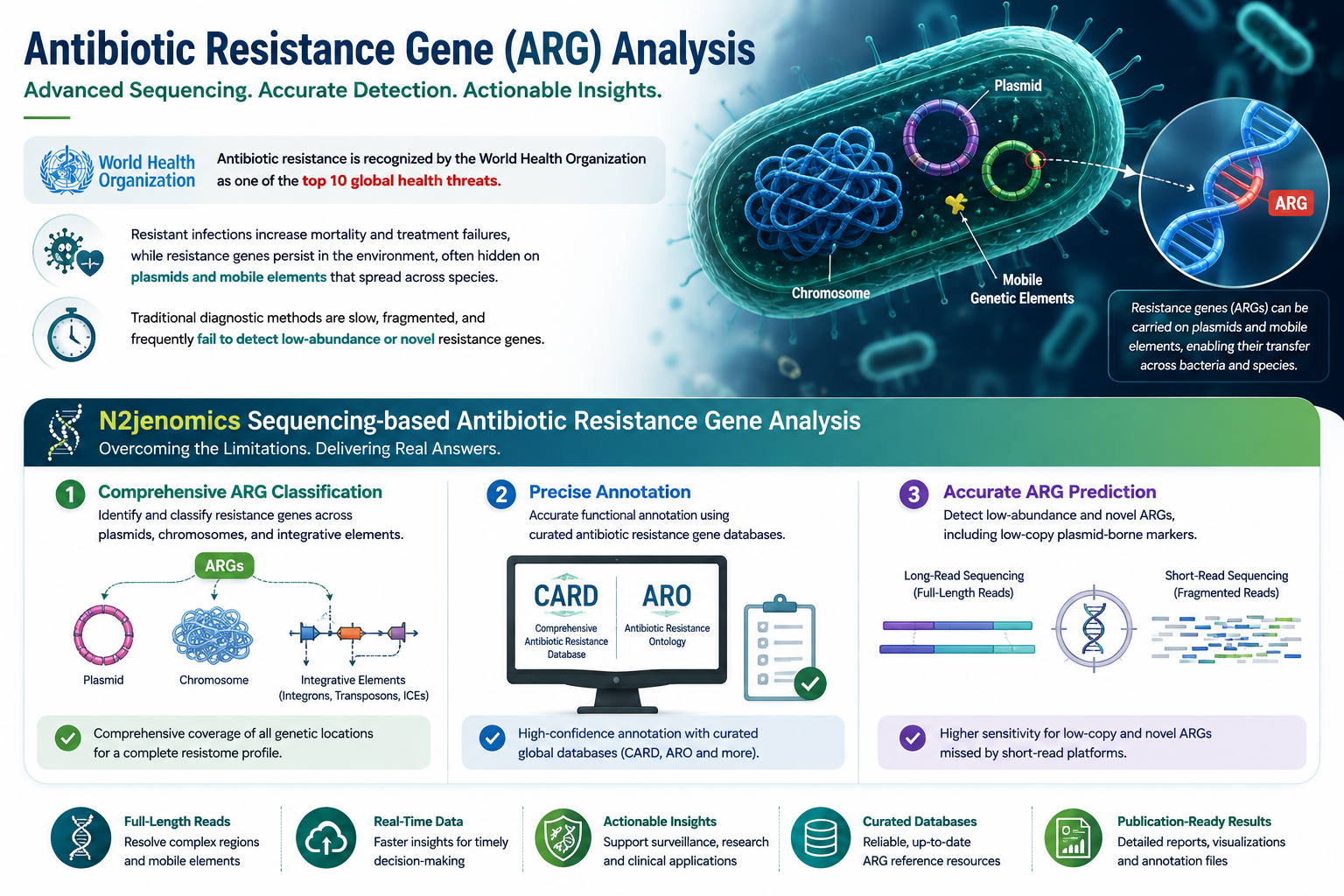
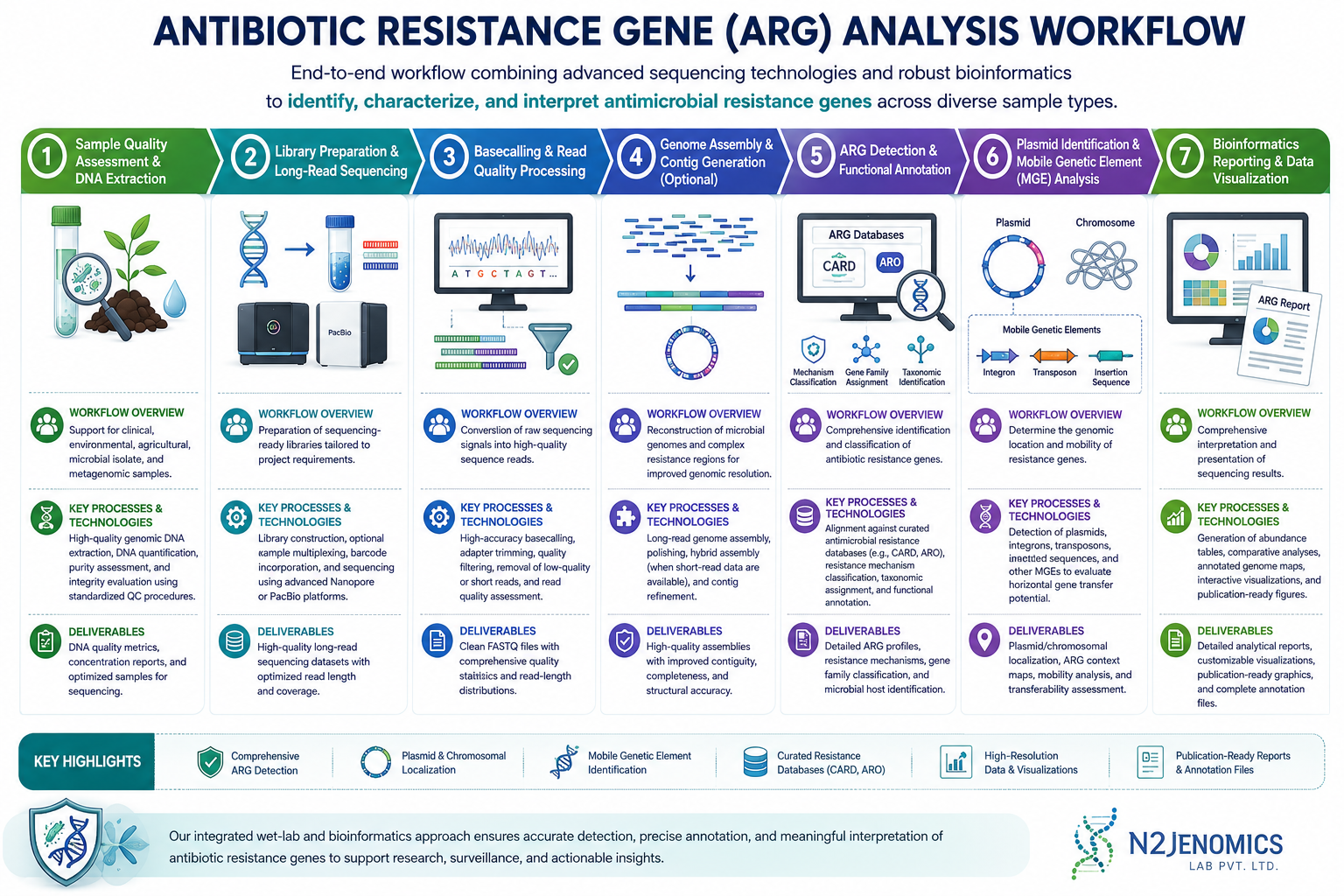
N2Jenomics Lab Pvt. Ltd. provides comprehensive Antibiotic Resistance Gene (ARG) Analysis services using advanced Long-Read Sequencing and Next-Generation Sequencing (NGS) technologies. Our end-to-end workflow enables the accurate detection, classification, and functional annotation of antibiotic resistance genes, including those located on plasmids, mobile genetic elements (MGEs), and metagenome-assembled genomes (MAGs).
Leveraging internationally recognized antibiotic resistance gene databases and state-of-the-art bioinformatics pipelines, we deliver highly accurate ARG identification, host attribution, and resistance profiling. Our services are designed to support academic research, biotechnology companies, pharmaceutical organizations, CROs, clinical microbiology, and environmental surveillance projects, providing reliable insights into antimicrobial resistance and gene transmission dynamics.
The rapid emergence of antimicrobial resistance (AMR) has become one of the most significant challenges facing global healthcare, agriculture, and environmental management. Antibiotic resistance genes (ARGs) enable microorganisms to survive antimicrobial treatments and can spread between bacterial populations through plasmids, transposons, integrons, and other mobile genetic elements (MGEs). Monitoring these genes is essential for understanding resistance mechanisms, tracking transmission pathways, and supporting effective public health strategies.
Conventional diagnostic approaches and short-read sequencing technologies may fail to identify rare, low-abundance, or structurally complex resistance genes, particularly when they are located within repetitive genomic regions or mobile genetic elements. These limitations can reduce the accuracy of resistome profiling and hinder comprehensive antimicrobial resistance surveillance.
At N2Jenomics Lab Pvt. Ltd., our sequencing-based Antibiotic Resistance Gene (ARG) Analysis service combines advanced Long-Read Sequencing and Next-Generation Sequencing (NGS) with powerful bioinformatics pipelines to deliver highly accurate resistome characterization. By generating long contiguous sequence reads and leveraging curated resistance gene databases, we enable precise identification, annotation, and genomic localization of antibiotic resistance genes across diverse sample types.
Our comprehensive Antibiotic Resistance Gene Analysis service provides:

| Analysis Category | Basic Analysis | Advanced Analysis | Multi-Omics Integrated Analysis |
|---|---|---|---|
| ARG Detection & Annotation | Identify known antibiotic resistance genes (ARGs) by aligning reads/contigs to curated antibiotic resistance gene databases (e.g. CARD, ARO); classify by gene family, resistance mechanism. | Predict novel or low homology ARGs; analyze ARG gene clusters (co-located genes), mobile genetic elements (transposons, integrons); functional annotation of resistance mechanisms. | Combine metagenomic + transcriptomic data to determine which ARGs are expressed; proteomics to verify resistance enzyme production; correlate ARG presence with phenotypic data or expression levels. |
| Host / Taxonomy Mapping | Assign ARGs to taxonomic levels (species, genus, family) using classification tools. | Co-localization of ARGs with host microbial genomes; construct ARG-host network; infer host range and potential spread. | Integrate metatranscriptome or single cell data to see active hosts; combine with 16S/shotgun for diversity; link expression / proteome to host identity. |
| Plasmid vs Chromosome & Mobility | Distinguish whether ARGs are plasmid-borne vs chromosomal; detection of known MGEs. | Detailed mapping of plasmid structures, detection of novel plasmid fusion events; identification of insertion sequences, integrative conjugative elements; estimate plasmid copy number. | Use long-read + short-read (hybrid) sequences plus transcriptomics / proteomics to confirm active mobile element usage; combine with methylation or epigenomic data to assess mobility regulation. |
| Abundance & Diversity Profiling | Quantify ARG abundance (normalized counts), diversity metrics (e.g. Shannon, Simpson), compare across samples. | Differential abundance across conditions; co-occurrence network of ARG classes; machine learning to detect marker ARGs; trend detection. | Compare metagenome vs metatranscriptome: abundance vs expression; correlate environmental/clinical metadata with ARG diversity; integrate metabolomics / environmental variables to detect selection pressures. |
| Visualization & Reporting | Basic visual outputs: bar plots, heat maps, ARG classification tables. | ARG cluster maps, plasmid vs chromosome diagrams, host-ARG network graphs, mobile element context visualisations. | Multi-omics visual dashboards: expression vs gene copy number, co-occurrence across omics, PCA/PCoA / network diagrams showing omics relationships. |
| Quality Control & Confidence | Filtering by read quality, minimum alignment identity and coverage; thresholding to reduce false positives; use of curated antibiotic resistance gene databases. | Validation of low abundance ARGs; coverage depth support; cross-validation among reads/assemblies; assessment of gene context; use of multiple databases / models. | Cross-omic validation: expression confirmation, proteomic evidence; consistency across datasets; environmental or phenotypic validation where available. |
Our ARG Analysis service supports a wide range of research, surveillance, and applied science applications. Below are key use cases for academic labs, CROs, and institutions.
Q: What is an Antibiotic Resistance Gene Analysis service and how can it help my research?
Antibiotic Resistance Gene Analysis is a service that uses sequencing (e.g. Nanopore long reads) and bioinformatics to detect, classify, and annotate antibiotic resistance genes (ARGs) in your samples; it helps labs, CRO clients, and academic institutions to discover ARG types (plasmid-borne or chromosomal), predict resistance mechanisms, track mobile genetic elements, and quantify ARG abundance to support surveillance, diagnostics, or agricultural/environmental studies.
Q: How accurate is ARG classification and annotation using curated resistance gene databases?
When using curated antibiotic resistance gene databases (like CARD/ARO/SARG), combined with high-quality long reads (e.g. from Nanopore), the annotation and classification of ARGs are very accurate; matching thresholds (identity, coverage) ensure genes are correctly assigned, and plasmid vs chromosome assignment gives context for mobile ARGs, reducing misclassification and helping in resistance prediction.
Q: Can you distinguish ARGs on plasmids from those on chromosomes, and why does this matter?
Yes, part of the analysis workflow involves plasmid vs chromosome assignment by detecting plasmid sequences and mobile genetic elements (MGEs), so we can tell if an ARG is likely transferable; this distinction matters because plasmid-borne ARGs spread more readily between bacteria, increasing risk, and knowing the location improves understanding of gene mobility and epidemiology.
Q: Do I need a higher volume or special quality of DNA for ARG detection?
To achieve reliable detection, especially for low-abundance ARGs or plasmid localization, high molecular weight DNA with good purity is preferred; though we can work with a range of sample types, quality filtering and library prep steps are optimized to reduce noise and improve confidence in antibiotic resistance gene prediction.
Q: How do you ensure low false positives in ARG detection and prediction?
We use stringent bioinformatics pipelines including basecalling quality control, read trimming, alignment to curated antibiotic resistance gene databases, filtering by sequence identity and coverage thresholds, and verification of gene context (neighboring mobile elements or chromosome/plasmid assignment) so that predictions of antibiotic resistance genes are robust and reliable.
Q: Can this service be used for both clinical samples and environmental or agricultural samples?
Yes, this ARG analysis is applicable to a variety of sample types—clinical isolates, wastewater, soil, livestock microbiomes, etc.—since the methods detect ARGs across diverse microbial communities; the same classification, annotation, and plasmid assignment capabilities apply, though sample preparation and depth may vary depending on environment or matrix type.
Q: What kind of outputs and reports will I receive from the ARG analysis service?
You will receive annotated tables of ARGs (gene name, mechanism/class, host taxa), abundance and diversity profiling, plasmid vs chromosome localization maps, visualizations (heat maps, gene cluster diagrams, network plots), raw and processed sequence files, and methods/QC documentation for reproducibility.
Q: What related sequencing services can complement the ARG Analysis?
Services like Nanopore Ultra-Long Sequencing, Nanopore Amplicon Sequencing, Nanopore Target Sequencing, Nanopore Full-Length lncRNA Sequencing, Nanopore Full-Length Transcript Sequencing, Nanopore Direct RNA Sequencing, and the general Nanopore Sequencing Overview are all complementary offerings that can enhance ARG detection (for example, ultra-long reads help resolve large plasmids, amplicon or targeted approaches help validate specific genes) enhancing the overall understanding of antibiotic resistance gene plasmid location, classification, and annotation.