Genomic Data Analysis Home  >  Bioinformatics  > Genomic Data Analysis
Genomic Data Analysis

At N2Jenomics Lab Pvt. Ltd., our proprietary GenSeq™ Technology powers comprehensive Genome Data Analysis services, enabling researchers to transform complex sequencing data into meaningful biological insights. Backed by an experienced team of bioinformaticians and computational biologists, we provide robust, accurate, and scalable data analysis solutions for academic institutions, biotechnology companies, healthcare organizations, and contract research projects.

Whether your study involves whole-genome sequencing, transcriptomics, metagenomics, population genetics, or comparative genomics, our end-to-end bioinformatics workflows are designed to deliver reliable, publication-ready results.


What Is Genome Data Analysis


Genome data analysis is the process of processing, interpreting, and extracting biologically meaningful information from genomic sequencing data. It involves the application of advanced bioinformatics tools, computational algorithms, and statistical methods to analyze DNA or RNA sequences and uncover genetic variations, functional elements, and biological relationships.

A genome represents the complete genetic blueprint of an organism, containing both coding and non-coding DNA sequences. Through genome data analysis, researchers can identify genes, characterize genetic variants, study gene regulation, investigate evolutionary relationships, and understand the molecular mechanisms underlying biological traits and diseases.

Genome data analysis has become an essential component of modern life sciences and supports a broad range of applications, including genomics research, precision medicine, agriculture, biotechnology, microbial genomics, and drug discovery.


Key Components of Genome Data Analysis


Sequence Alignment - High-quality sequencing reads are aligned to a reference genome or assembled de novo to accurately determine their genomic locations, providing the foundation for downstream analyses.


Variant Detection - Genetic variations  including single nucleotide polymorphisms (SNPs), insertions/deletions (Indels), structural variants (SVs), and copy number variations (CNVs)—are identified, filtered, and annotated to understand their biological significance.


Gene Expression Analysis -  RNA sequencing data is analyzed to quantify gene expression levels, identify differentially expressed genes, and investigate transcriptional changes across different tissues, treatments, or experimental conditions.


Functional Annotation -  Genes, genetic variants, and regulatory elements are annotated using established biological databases to predict their functions, biological roles, and potential impact on cellular processes.


Comparative Genomics -  Whole genomes from different individuals or species are compared to identify conserved regions, evolutionary relationships, genomic rearrangements, and species-specific adaptations.


Epigenomic Analysis -  Epigenetic modifications, including DNA methylation and histone modifications, are analyzed to better understand gene regulation, chromatin organization, and epigenetic inheritance.


Metagenomic Analysis -  Complex microbial communities are characterized by analyzing sequencing data from environmental or clinical samples, enabling taxonomic profiling, microbial diversity assessment, and functional characterization.


Pathway and Network Analysis -  Genes and proteins are mapped onto biological pathways and interaction networks to identify key molecular mechanisms, signaling pathways, and functional relationships associated with specific phenotypes or diseases.


Genome data analysis plays a pivotal role in advancing biological and biomedical research by transforming raw sequencing data into actionable knowledge. Its applications span disease research, biomarker discovery, precision medicine, crop improvement, evolutionary biology, industrial biotechnology, and pharmaceutical development.

  •  

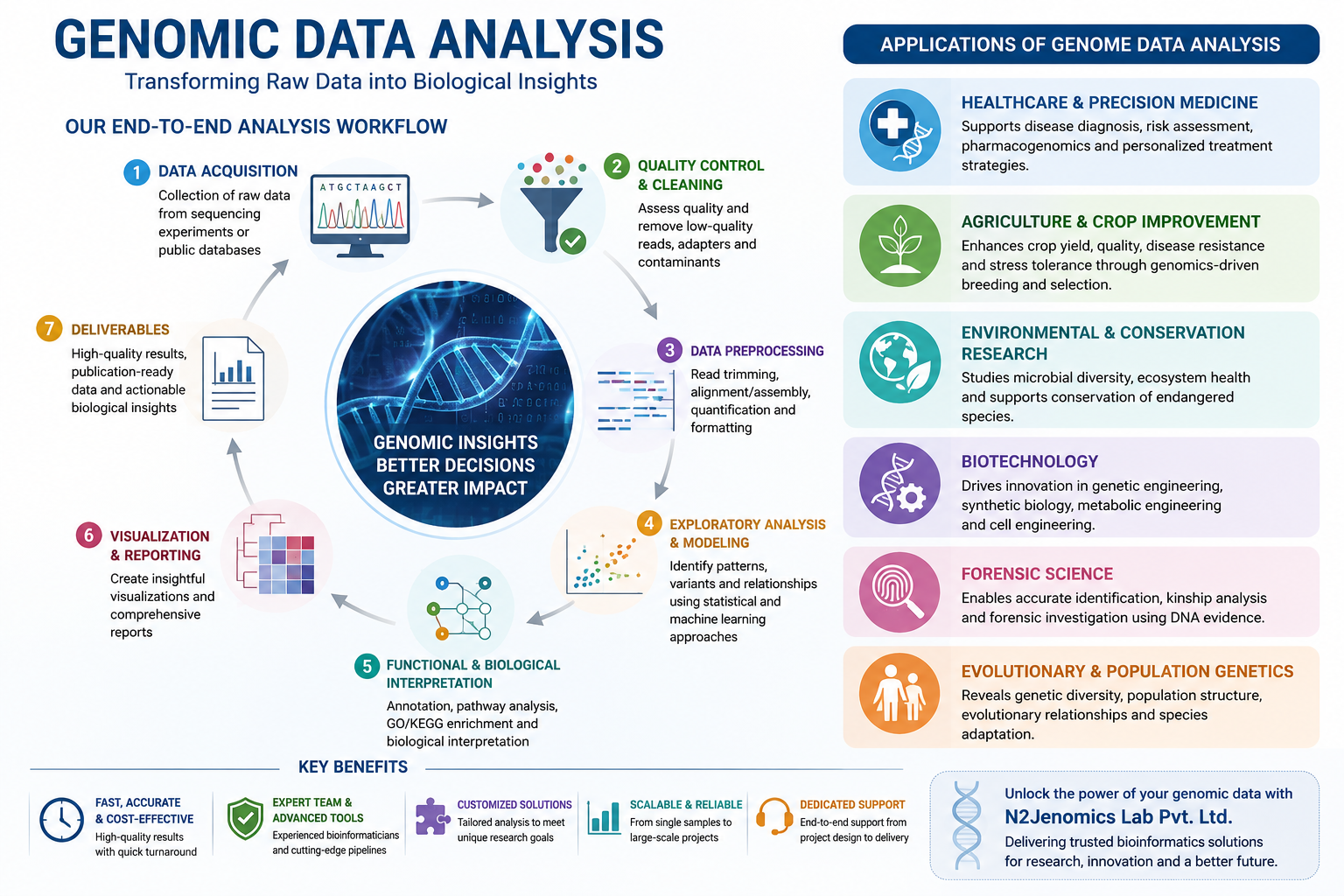
Genome Data Analysis Workflow


At N2Jenomics Lab Pvt. Ltd., we follow a standardized, reproducible, and scalable workflow to ensure high-quality genomic analyses and reliable scientific outcomes.

1. Data Acquisition

The workflow begins with the collection of raw sequencing data generated from high-throughput sequencing platforms or obtained from publicly available genomic repositories. Depending on the study, data may include DNA sequencing, RNA sequencing, metagenomic sequencing, or other omics datasets.

2. Quality Assessment and Data Cleaning

Raw sequencing data undergoes comprehensive quality control to evaluate sequencing accuracy and identify potential technical issues. Low-quality reads, sequencing adapters, contaminants, and artifacts are removed to improve data integrity and ensure reliable downstream analysis.

3. Data Preprocessing

Following quality control, sequencing reads are processed and prepared for analysis. This stage includes read trimming, error correction, reference genome alignment or de novo assembly, duplicate removal, and expression quantification where applicable. These preprocessing steps generate clean, analysis-ready datasets.

4. Exploratory Data Analysis and Statistical Modeling

Processed datasets are examined using statistical and computational approaches to identify meaningful biological patterns, relationships, and variations. Advanced analytical techniques, including machine learning, clustering, dimensionality reduction, and differential analysis, are applied to extract biologically relevant insights and support hypothesis generation.

5. Biological Interpretation and Functional Analysis

Significant genes, variants, or genomic regions are functionally annotated and interpreted using curated biological databases. Pathway enrichment, Gene Ontology (GO) analysis, protein interaction networks, and other downstream analyses help uncover the biological significance of the findings.

6. Data Visualization and Reporting

The final stage focuses on presenting results through publication-quality visualizations and comprehensive analytical reports. Interactive plots, heatmaps, genome browsers, volcano plots, PCA analyses, phylogenetic trees, pathway diagrams, and other customized visualizations are generated to clearly communicate biological insights and facilitate scientific interpretation.

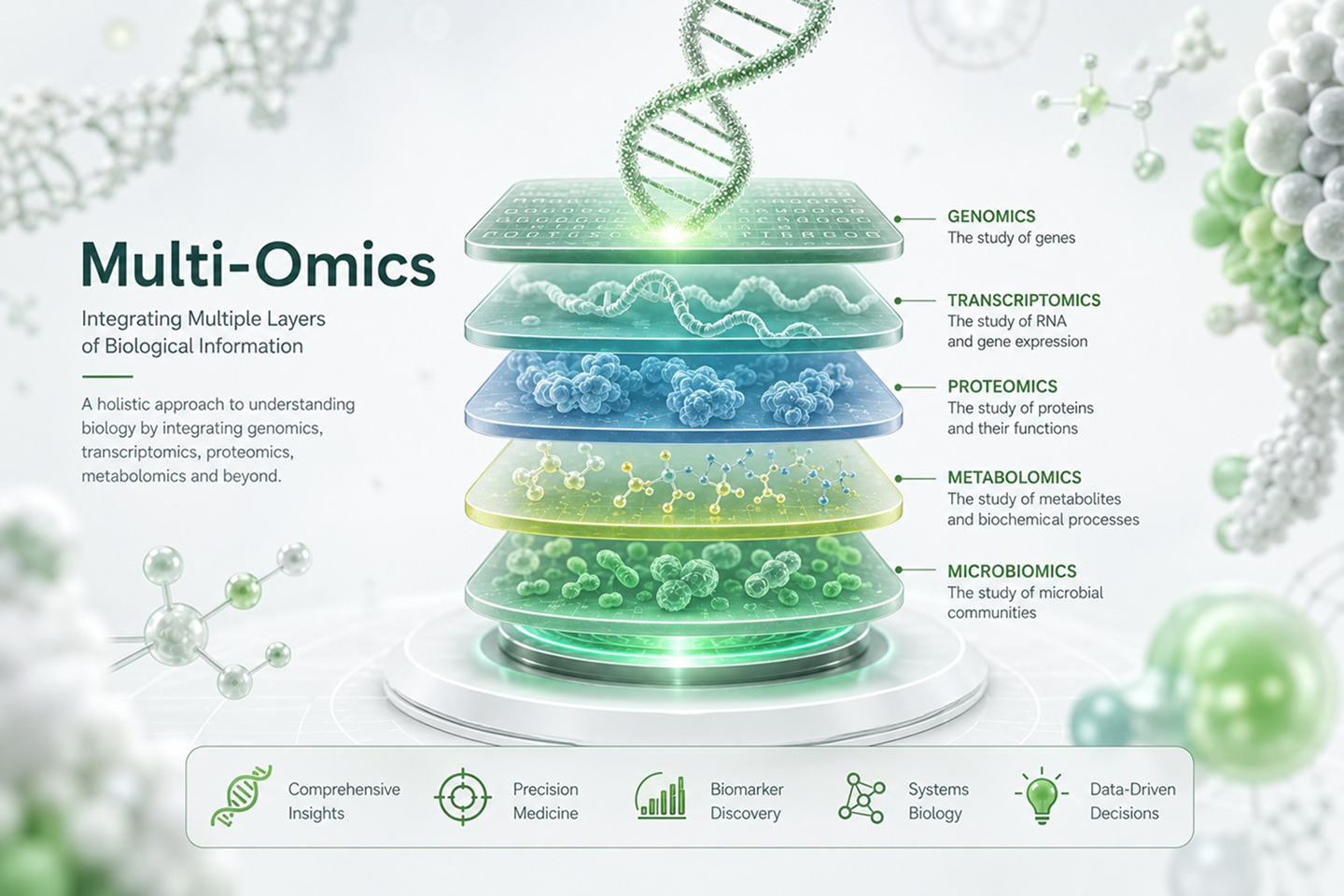
Genomic Data Analysis
  • De Novo Genome Sequencing Data Analysis

  •  
  • De novo genome sequencing is a powerful approach used to assemble an organism's genome without relying on an existing reference genome. It is particularly valuable for newly discovered or poorly characterized species, as well as for organisms expected to exhibit substantial genomic variation compared to available reference genomes.
  • Unlike reference-guided assembly, de novo sequencing reconstructs the genome directly from sequencing reads by identifying overlapping DNA fragments and assembling them into longer contiguous sequences (contigs and scaffolds). Advanced assembly algorithms and high-throughput sequencing technologies are employed to generate accurate, high-quality genome assemblies suitable for downstream genomic analyses.
  • Because de novo genome assembly involves reconstructing an entire genome from scratch, projects often incorporate multiple sequencing libraries and complementary sequencing technologies—such as short-read and long-read platforms—to improve assembly continuity, accuracy, and completeness.
  • At N2Jenomics Lab Pvt. Ltd., our comprehensive De Novo Sequencing Data Analysis services combine state-of-the-art bioinformatics pipelines with extensive genomics expertise to deliver high-quality, publication-ready genome assemblies and detailed biological insights.
  •  

  • Our De Novo Genome Analysis Services Include

  •  
  • • High-quality genome assembly using advanced de novo assembly algorithms

  • • Generation of chromosome-scale reference genomes through optimized assembly workflows
  • • Structural gene annotation, including prediction of protein-coding genes, non-coding RNAs, and genomic features
  • • Functional annotation using leading biological databases and annotation pipelines
  • • Identification and characterization of gene families, including resistance (R) genes and other functionally important gene clusters
  • • Phylogenetic and comparative genomics analysis to investigate evolutionary relationships among species
  • • Prediction and annotation of biosynthetic pathways associated with specialized metabolites and other biological processes
  • • Genome quality assessment, completeness evaluation, and assembly validation
  • • Publication-ready reports, figures, and comprehensive analytical documentation

Gene Prediction and Genome Annotation


Following successful genome sequencing and assembly, the next critical step is gene prediction and genome annotation, which enables researchers to uncover the functional elements encoded within the genome. Genome annotation identifies the locations, structures, and biological roles of genes and other genomic features, providing the foundation for downstream functional and comparative genomics studies.

The primary objective of genome annotation is to accurately identify protein-coding genes, characterize their encoded proteins, and annotate other functional genomic elements such as regulatory regions, non-coding RNAs, and repetitive sequences. High-quality annotation transforms raw genome assemblies into biologically meaningful resources that support gene discovery, evolutionary analysis, molecular breeding, and biomedical research.


At N2Jenomics Lab Pvt. Ltd., we provide comprehensive gene prediction and genome annotation services for both de novo genome assemblies and reference-guided resequencing projects. Our advanced bioinformatics pipelines integrate multiple evidence sources to generate accurate, reliable, and publication-ready genome annotations.


Our Gene Prediction and Annotation Services Include

  •  
  • • Ab initio and evidence-based gene prediction for accurate identification of protein-coding genes

  • • Structural and functional annotation of predicted genes and proteins
  • • Annotation of small and long non-coding RNAs (ncRNAs), including tRNA, rRNA, miRNA, snoRNA, snRNA, and lncRNA
  • • Identification and classification of gene and protein families
  • • Functional characterization using leading biological databases and annotation resources
  • • Metabolic pathway reconstruction and pathway annotation through GO, KEGG, and other curated databases
  • • Comparative annotation with closely related reference genomes
  • • Generation of comprehensive annotation reports and publication-ready datasets

Once a high-quality reference genome is available, genome resequencing enables researchers to compare the genomes of multiple individuals within the same species—or closely related species—to identify genetic variations and investigate their biological significance. By aligning sequencing reads to the reference genome, resequencing provides a highly accurate and cost-effective approach for detecting genomic differences associated with important traits, diseases, evolution, and population diversity.

Genome resequencing is widely applied in population genetics, crop improvement, evolutionary biology, precision medicine, molecular breeding, and genome-wide association studies (GWAS). It allows researchers to discover both small and large genomic variants, understand population structure, and identify genetic markers linked to phenotypic traits.

At N2Jenomics Lab Pvt. Ltd., we offer comprehensive Genome Resequencing Data Analysis services using robust bioinformatics pipelines and advanced computational tools to generate accurate, reliable, and publication-ready results.

Our Genome Resequencing Analysis Services Include

  •  
  • • Identification of small genetic variants, including Single Nucleotide Polymorphisms (SNPs) and small insertions/deletions (Indels)
  • • Detection of large structural variants (SVs), including deletions, insertions, duplications, inversions, translocations, and other genomic rearrangements
  • • Copy Number Variation (CNV) analysis to identify genomic gains and losses
  • • Presence–Absence Variation (PAV) analysis for comparative genomics and pan-genome studies
  • • Genome consensus sequence reconstruction based on identified genetic variants
  • • Genome-Wide Association Studies (GWAS) to identify genomic loci associated with important phenotypic traits
  • • High-throughput genotyping for genetic diversity, marker discovery, and breeding applications
  • • Population genetics and molecular evolution analysis to investigate genetic diversity, phylogenetic relationships, and evolutionary history
  • • Comprehensive variant annotation and functional interpretation using established genomic databases
  • • Publication-ready reports, visualizations, and expert bioinformatics support

Advantages of Genomic Data Analysis

• Comprehensive Genomic Insights -  Genome data analysis provides a comprehensive understanding of an organism's genetic makeup by transforming raw sequencing data into meaningful biological information. It enables researchers to explore genes, genetic variants, regulatory elements, and functional pathways within a single integrated workflow.


• End-to-End Bioinformatics Expertise -  Our experienced bioinformatics team supports every stage of the analysis process, from experimental design and sequencing strategy to advanced data processing, statistical analysis, functional annotation, and biological interpretation. This ensures accurate, reproducible, and high-quality results for every project.


• Fast, Accurate, and Cost-Effective Analysis -  Optimized computational pipelines and high-performance computing infrastructure enable rapid turnaround times while maintaining exceptional analytical accuracy. Our streamlined workflows deliver reliable results in a cost-effective manner without compromising quality.


• Broad Compatibility Across Sample Types -  Our genome data analysis solutions are suitable for a wide range of organisms and sample types, including human, animal, plant, microbial, fungal, and environmental samples. This versatility supports diverse research applications across life sciences, biotechnology, agriculture, and healthcare.


• Accelerating Genomics Research -  By leveraging advanced sequencing technologies, validated bioinformatics workflows, and cutting-edge analytical methods, genome data analysis accelerates scientific discovery, enabling researchers to uncover novel biological insights and drive innovation in genomics.


• Flexible and Customized Workflows -  Every research project is unique. Our analysis pipelines can be customized to meet specific experimental objectives, sequencing platforms, genome types, and downstream analytical requirements, ensuring solutions tailored to your scientific goals.


• Expert Scientific Consultation -  We work closely with researchers throughout the project lifecycle, providing technical guidance on study design, sequencing strategies, data interpretation, and downstream analyses. Our consultative approach helps identify the most effective and budget-conscious solutions while maximizing the scientific value of each project.


• Publication-Ready Results -  Our comprehensive reports include high-quality visualizations, statistical analyses, annotated datasets, and biological interpretations that are suitable for publication, grant applications, and downstream research.


• Scalable and Reproducible Pipelines -  Whether analyzing a single genome or hundreds of sequencing datasets, our scalable bioinformatics workflows ensure consistent, reproducible, and reliable results across projects of any size.


• Dedicated Technical Support - Fr om project planning to final report delivery, our multidisciplinary team provides continuous scientific and technical support, ensuring a seamless experience and timely completion of your genomics research project.

Application of Genomic Data Analysis

  • • Healthcare and Precision Medicine - Genome data analysis supports disease prevention, diagnosis, and personalized treatment by identifying genetic variants associated with inherited and complex diseases. It also contributes to pharmacogenomics, ancestry studies, and precision medicine.

  •  

  • • Agriculture and Crop Improvement -  Genomic analysis helps improve crop yield, quality, disease resistance, and tolerance to environmental stresses. It supports marker-assisted breeding, genomic selection, and the development of climate-resilient crop varieties.

  •  

  • • Environmental and Conservation Research - Genome data analysis is widely used to study microbial communities, monitor biodiversity, and conserve endangered species through genetic diversity and population studies.

  •  

  • • Biotechnology - Genomic insights drive advancements in genetic engineering, synthetic biology, metabolic engineering, and cell engineering, supporting innovation in biotechnology and industrial research.

  •  

  • • Forensic Science - Analysis of DNA from biological samples enables accurate individual identification, kinship analysis, and forensic investigations, making it an essential tool in modern forensic science.

  •  

  • • Evolutionary and Population Genetics -  Genome data analysis helps researchers understand genetic diversity, population structure, evolutionary relationships, and species adaptation across different organisms.

Address: Registered Office: 138, Patparganj Industrial Area, New Delhi – 110092, India
Email: info@n2jenomicslab.com
Phone: +91-8287121443 +91-9870548477
Operational Address: National Institute of Plant Genome Research (BRIC - NGGF) Lab No. 206 and 207, Aruna Asaf Ali Marg, P.O. Box No. 10531, New Delhi – 110067, India
Follow Us:
15,950 Total Visitors
Copyright © 2026 | All rights reserved N2Jenomics Lab Pvt Ltd