Full-Length Transcripts Sequencing (Iso-Seq)
Home
>
PacBio SMRT Sequencing
> Full-Length Transcripts Sequencing (Iso-Seq)
PacBio Iso-Seq Full-Length Transcript Sequencing Service
N2Jenomics Lab Pvt. Ltd. provides PacBio Iso-Seq Full-Length Transcript Sequencing services for comprehensive transcriptome analysis without the need for transcript reconstruction. Powered by PacBio Single Molecule, Real-Time (SMRT®) sequencing, Iso-Seq captures complete RNA transcripts from the 5′ untranslated region (5′ UTR) to the 3′ poly(A) tail in a single continuous read, enabling accurate characterization of transcript diversity, alternative splicing, and gene structure.
Our end-to-end service combines optimized laboratory workflows, rigorous quality control, and advanced bioinformatics analysis to deliver high-quality, publication-ready transcriptomic data for researchers in genomics, agriculture, biotechnology, and biomedical sciences.
What is PacBio Iso-Seq?
PacBio Isoform Sequencing (Iso-Seq) is a long-read transcript sequencing technology designed to generate full-length cDNA sequences without fragmenting RNA transcripts or relying on computational transcript assembly.
Unlike conventional short-read RNA sequencing, which reconstructs transcripts from millions of short fragments, Iso-Seq directly sequences each transcript as a single molecule. This enables highly accurate identification of transcript isoforms, alternative splicing events, transcription start and end sites, fusion transcripts, and novel genes.
Because every transcript is sequenced in its entirety, Iso-Seq provides a more complete and biologically accurate representation of the transcriptome.
Why Choose Iso-Seq?
Alternative splicing enables a single gene to produce multiple transcript isoforms with distinct biological functions. Accurately identifying these isoforms is essential for understanding gene regulation, development, disease mechanisms, and functional genomics.
Traditional short-read RNA sequencing can identify gene expression but often struggles to reconstruct complete transcript structures, particularly for complex genes with multiple splice variants.
PacBio Iso-Seq overcomes these limitations by generating full-length transcript sequences that preserve complete transcript architecture from the transcription start site to the poly(A) tail.
This enables researchers to:
• Accurately identify transcript isoforms
• Characterize alternative splicing events
• Discover novel transcripts and genes
• Detect fusion transcripts
• Differentiate highly similar homologous genes
• Perform allele-specific transcript analysis
• Improve genome annotation
The long-read capability of PacBio sequencing also facilitates detection of complex transcript structures, including long polycistronic transcripts and overlapping transcriptional regions that may be difficult to resolve using short-read technologies.
Key Features & Advantages
• Complete Full-Length Transcript Sequencing
Sequence complete RNA molecules from the 5′ UTR to the poly(A) tail, eliminating the need for transcript reconstruction.
• Accurate Isoform Identification
Precisely identify transcript isoforms and characterize transcript diversity with high confidence.
• Alternative Splicing Analysis
Detect known and novel splice variants, alternative splice sites, exon skipping events, and transcript isoforms.
• Novel Transcript Discovery
Identify previously unannotated transcripts, novel exons, and new gene models to improve genome annotation.
• Fusion Transcript Detection
Accurately characterize fusion genes and complex transcript rearrangements using long-read sequencing.
• High-Quality Transcriptome Annotation
Generate comprehensive transcript datasets that improve reference genome annotation for both model and non-model organisms.
• Quantitative Transcript Analysis
When integrated with complementary RNA sequencing workflows, Iso-Seq supports accurate quantification of gene and transcript expression.
• Broad Species Compatibility
Suitable for organisms with or without a reference genome, making Iso-Seq ideal for both established and emerging genomic models.
Applications
• Genome Annotation
Improve genome annotation by generating high-confidence full-length transcript models that accurately define gene structures.
• Transcriptome Profiling
Characterize transcript diversity across tissues, developmental stages, environmental conditions, or experimental treatments.
• Alternative Splicing Research
Investigate complex splicing patterns, isoform switching, exon usage, and transcript diversity associated with biological processes and disease.
• Cancer & Disease Research
Identify fusion transcripts, disease-associated splice variants, and transcriptomic biomarkers relevant to cancer and genetic disorders.
• Agricultural & Plant Genomics
Support crop improvement, functional genomics, stress response studies, and breeding programs through comprehensive transcriptome characterization.
• Comparative & Evolutionary Genomics
Compare transcript structures across species to investigate gene evolution, functional divergence, and regulatory complexity.
PacBio Iso-Seq Workflow
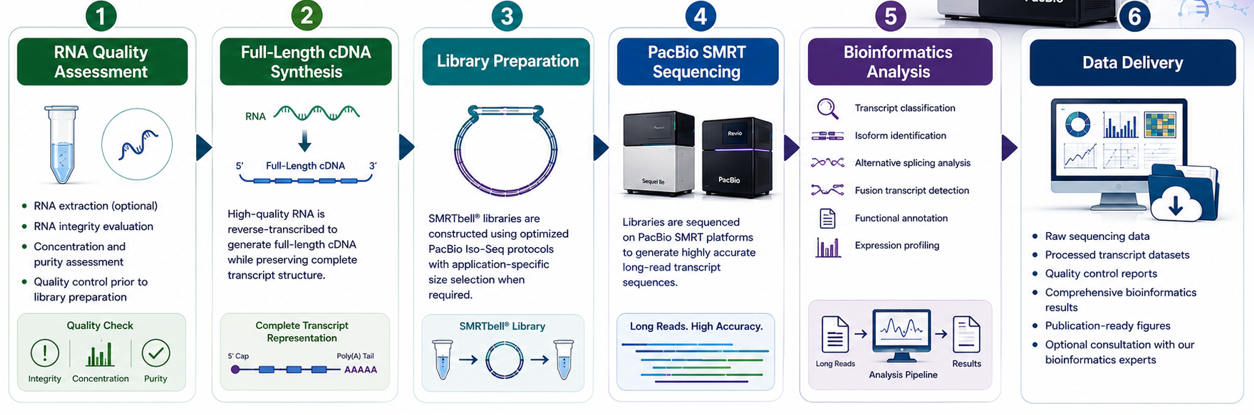
N2Jenomics Lab Pvt. Ltd. provides a complete Iso-Seq workflow designed to generate accurate full-length transcript datasets.
1. RNA Quality Assessment
• RNA extraction (optional)
• RNA integrity evaluation
• Concentration and purity assessment
• Quality control prior to library preparation
2. Full-Length cDNA Synthesis
High-quality RNA is reverse-transcribed to generate full-length cDNA while preserving complete transcript structure.
3. Library Preparation
SMRTbell® libraries are constructed using optimized PacBio Iso-Seq protocols with application-specific size selection when required.
4. PacBio SMRT Sequencing
Libraries are sequenced on PacBio SMRT platforms to generate highly accurate long-read transcript sequences.
5. Bioinformatics Analysis
Comprehensive analysis includes transcript classification, isoform identification, alternative splicing analysis, fusion transcript detection, functional annotation, and expression profiling.
6. Data Delivery
Clients receive raw sequencing data, processed transcript datasets, quality control reports, comprehensive bioinformatics results, and publication-ready figures.
Note: Recommended data outputs and analysis contents displayed are for reference only. For detailed information, please contact us with your customized requests.
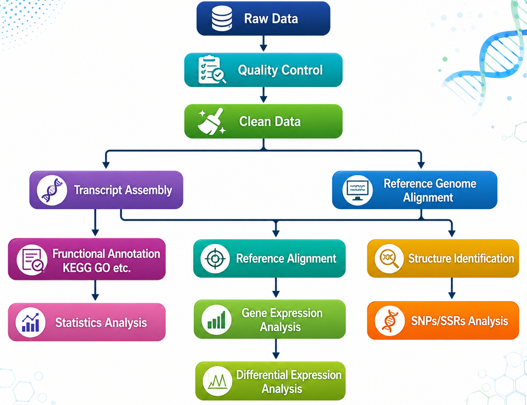
Analysis Pipeline
Deliverables
• The original sequencing data
• Experimental results
• Data analysis report
• Details in Iso-Seq for your writing (customization)
1. What is the difference between a transcript and an isoform?
A transcript is an RNA molecule produced during the transcription of a gene. An isoform is a specific version of that transcript generated through mechanisms such as alternative splicing, alternative promoter usage, or alternative polyadenylation.
While a single gene may produce multiple transcript isoforms, each isoform can differ in exon composition, untranslated regions (UTRs), or coding sequences, potentially leading to proteins with distinct biological functions. PacBio Iso-Seq accurately captures these full-length transcript variants, enabling comprehensive isoform characterization.
2. What types of transcripts are best suited for Iso-Seq?
Iso-Seq is designed to sequence full-length RNA transcripts, making it particularly valuable for studying complex transcriptomes.
Typical transcript characteristics include:
• Complete transcript coverage from the 5′ end to the 3′ poly(A) tail
• Transcript lengths commonly ranging from 1–10 kb, depending on the organism
• Multiple transcript isoforms generated through alternative splicing
• Protein-coding and selected non-coding RNA transcripts with poly(A) tails
Because Iso-Seq sequences entire transcripts without fragmentation, it accurately resolves transcript structures that are difficult to reconstruct using short-read sequencing.
3. Can Iso-Seq analyze both whole transcriptomes and targeted genes?
Yes. PacBio Iso-Seq supports both whole-transcriptome profiling and targeted transcript sequencing.
Depending on the experimental design, libraries can be prepared for:
• Whole-transcriptome sequencing
• Targeted gene panels
• Single-sample projects
• Multiplexed sequencing using sample-specific barcodes
This flexibility allows researchers to customize sequencing strategies according to their study objectives while maintaining high-quality full-length transcript information.
4. How is Iso-Seq data processed before analysis?
Raw sequencing data undergoes several quality control and preprocessing steps before downstream bioinformatics analysis.
The standard workflow typically includes:
• Generation of high-accuracy HiFi consensus reads
• Barcode identification and sample demultiplexing (for multiplexed projects)
• Removal of sequencing adapters and poly(A) sequences when appropriate
• Identification of full-length non-chimeric reads
• Read clustering and consensus transcript generation
• Transcript classification and quality filtering
These preprocessing steps produce high-confidence full-length transcript sequences for subsequent analyses such as isoform discovery, alternative splicing analysis, genome annotation, and fusion transcript detection.
5. What advantages does Iso-Seq offer over conventional RNA sequencing?
Unlike short-read RNA sequencing, which reconstructs transcripts computationally from fragmented reads, Iso-Seq directly sequences complete RNA molecules. This enables:
• Accurate full-length transcript identification
• Reliable alternative splicing analysis
• Discovery of novel transcripts and isoforms
• Improved genome annotation
• Detection of fusion transcripts
• Characterization of allele-specific expression
The result is a more complete and biologically accurate view of transcriptome complexity.
6. Is a reference genome required for Iso-Seq analysis?
No. Iso-Seq can be applied to organisms with or without a high-quality reference genome.
For species with an available reference genome, Iso-Seq improves gene annotation and transcript characterization. For non-model organisms, it enables de novo transcript discovery and provides valuable resources for genome annotation and functional genomics studies.
7. Which research applications benefit most from Iso-Seq?
PacBio Iso-Seq is widely used in:
• Genome annotation
• Alternative splicing studies
• Transcript isoform discovery
• Cancer and disease research
• Plant and animal genomics
• Functional genomics
• Fusion gene detection
• Comparative transcriptomics
• Biomarker discovery
Its ability to generate complete transcript sequences makes it particularly valuable for studies involving complex gene regulation.
8. What deliverables are included with your Iso-Seq service?
Our PacBio Iso-Seq service includes:
• Raw sequencing data (FASTQ/BAM)
• High-quality full-length transcript sequences
• Quality control reports
• Isoform identification and classification
• Alternative splicing analysis
• Novel transcript discovery
• Functional annotation
• Publication-ready figures and visualizations
• Comprehensive bioinformatics and project report
Address:Registered Office: 138, Patparganj Industrial Area, New Delhi – 110092, India
Operational Address: National Institute of Plant Genome Research (BRIC - NGGF)
Lab No. 206 and 207, Aruna Asaf Ali Marg, P.O. Box No. 10531,
New Delhi – 110067, India