Mitochondrial DNA Copy Number Quantification Test
Home
>
CNV Genotyping
> Mitochondrial DNA Copy Number Quantification Test
Mitochondrial DNA Copy Number qPCR Service
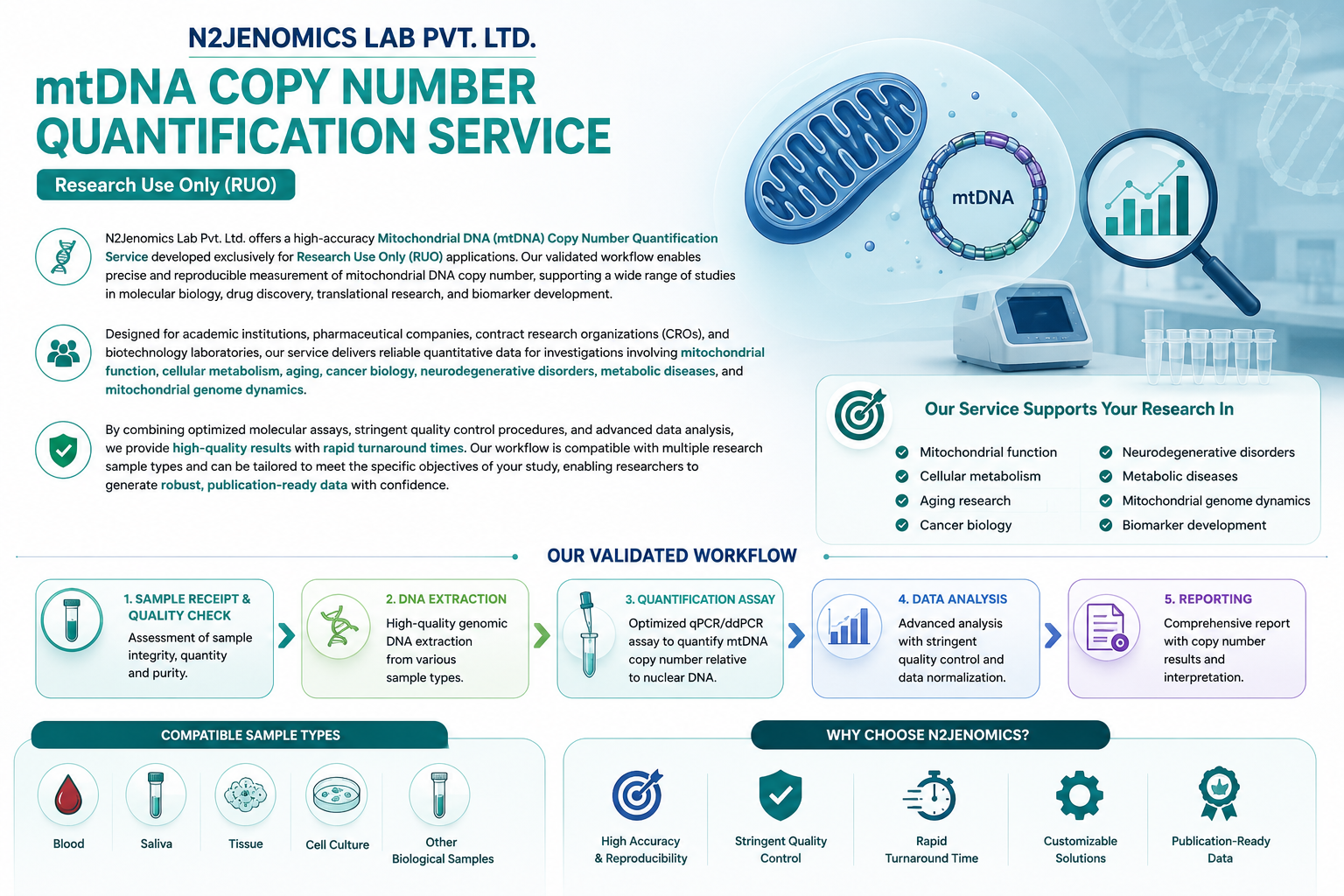
N2Jenomics Lab Pvt. Ltd. offers a high-accuracy Mitochondrial DNA (mtDNA) Copy Number Quantification Service developed exclusively for Research Use Only (RUO) applications. Our validated workflow enables precise and reproducible measurement of mitochondrial DNA copy number, supporting a wide range of studies in molecular biology, drug discovery, translational research, and biomarker development.
Designed for academic institutions, pharmaceutical companies, contract research organizations (CROs), and biotechnology laboratories, our service delivers reliable quantitative data for investigations involving mitochondrial function, cellular metabolism, aging, cancer biology, neurodegenerative disorders, metabolic diseases, and mitochondrial genome dynamics.
By combining optimized molecular assays, stringent quality control procedures, and advanced data analysis, we provide high-quality results with rapid turnaround times. Our workflow is compatible with multiple research sample types and can be tailored to meet the specific objectives of your study, enabling researchers to generate robust, publication-ready data with confidence.
Why Quantify Mitochondrial DNA (mtDNA) Copy Number?
Mitochondrial DNA Copy Number (mtDNA-CN) represents the number of mitochondrial genomes present within a cell and serves as an important indicator of mitochondrial abundance, function, and cellular energy metabolism. Variations in mtDNA-CN have been associated with numerous physiological and pathological conditions, making it a valuable biomarker in biomedical and translational research.
At N2Jenomics Lab Pvt. Ltd., we provide accurate, reproducible, and research-grade mtDNA Copy Number Quantification to support studies across oncology, metabolic disorders, aging, drug development, and mitochondrial biology.
Why Do Researchers Measure mtDNA Copy Number?
• Cancer Research
Alterations in mitochondrial DNA copy number have been reported in numerous cancer types, including breast, bladder, kidney, colorectal, and liver cancers. Measuring mtDNA-CN helps researchers investigate tumor biology, identify potential biomarkers, and evaluate therapeutic responses during oncology research.
• Aging and Metabolic Disease Research
Changes in mitochondrial content are closely linked to cellular aging and metabolic dysfunction. mtDNA Copy Number Quantification supports studies investigating aging, cardiovascular disease, diabetes, obesity, chronic kidney disease, neurodegenerative disorders, and mitochondrial dysfunction.
• Drug Discovery and Toxicity Assessment
Many pharmaceutical compounds can influence mitochondrial function. Monitoring mtDNA copy number enables researchers to evaluate mitochondrial toxicity, assess drug safety, compare candidate compounds, and study cellular responses to environmental or chemical stress.
• Mitochondrial Biology and Biomarker Discovery
Quantifying mtDNA copy number provides valuable insights into mitochondrial biogenesis, cellular metabolism, oxidative stress, and disease mechanisms, making it an important tool for biomarker discovery and translational research.
What Is Mitochondrial DNA Copy Number?
Unlike nuclear DNA, each cell contains numerous mitochondria, and every mitochondrion carries multiple copies of its own genome. Consequently, the total number of mitochondrial DNA molecules varies among different tissues, cell types, and physiological conditions.
Measuring the ratio of mitochondrial DNA to nuclear DNA enables researchers to estimate the average mitochondrial DNA copy number per cell. This measurement serves as a reliable indicator of mitochondrial abundance and overall cellular bioenergetic status.
Why Choose qPCR for mtDNA Copy Number Analysis?
Among the available analytical methods—including whole genome sequencing (WGS), digital PCR (dPCR), and microarray-based approaches—quantitative PCR (qPCR) remains one of the most widely adopted techniques for mtDNA copy number analysis due to its combination of accuracy, speed, scalability, and cost-effectiveness.
Key advantages include:
• High analytical sensitivity for low DNA input samples
• Excellent reproducibility across biological replicates
• Rapid turnaround time
• High-throughput processing for large-scale studies
• Cost-effective solution for routine research applications
• Compatible with diverse biological sample types
Our mtDNA Copy Number qPCR Assay
N2Jenomics Lab Pvt. Ltd. offers a TaqMan Probe-Based qPCR Assay designed for accurate and reproducible quantification of mitochondrial DNA copy number. The assay simultaneously amplifies mitochondrial DNA and a reference nuclear gene within the same reaction, enabling precise normalization and reliable estimation of mtDNA copy number.
This optimized workflow minimizes experimental variation while delivering consistent, publication-quality results suitable for academic, pharmaceutical, biotechnology, and CRO research projects.
Assay Technology
Our assay utilizes TaqMan hydrolysis probe chemistry, which provides exceptional analytical specificity and sensitivity. During PCR amplification, the probe is cleaved only after binding to its complementary DNA target, generating fluorescence proportional to the amount of amplified DNA.
To maximize assay accuracy:
• Conserved mitochondrial genomic regions are selected for amplification.
• Primers and probes are designed to minimize amplification of nuclear mitochondrial pseudogenes (NUMTs).
• A validated single-copy nuclear reference gene is amplified simultaneously for normalization.
• mtDNA copy number is calculated using the mitochondrial-to-nuclear DNA ratio.
Assay Performance
Our optimized workflow delivers reliable quantitative performance across a broad range of research applications.
• High Sensitivity
The assay accurately quantifies mtDNA copy number from low-input DNA samples, making it suitable for precious or limited research specimens.
• Excellent Precision
Optimized reaction conditions and stringent quality control ensure highly reproducible results with minimal technical variation across replicate experiments.
• Broad Dynamic Range
The assay demonstrates excellent linearity over a wide range of DNA concentrations, allowing accurate quantification across diverse sample types and input amounts.
• Primer and Probe Design
Our assay has been carefully designed to maximize specificity and analytical performance.
- Primers target highly conserved mitochondrial genomic regions such as ND1 or the D-loop.
- Nuclear reference assays target validated single-copy genes for accurate normalization.
- Primer and probe sequences undergo comprehensive computational and experimental validation.
- Specificity is confirmed using in-silico sequence analysis, amplification controls, and quality assessment procedures to minimize off-target amplification.
One-Step Copy Number Quantification
The assay simultaneously amplifies mitochondrial DNA and nuclear DNA within a single reaction, reducing technical variability while improving workflow efficiency.
Data analysis supports both:
• Relative mtDNA Copy Number using comparative Ct (ΔΔCt) analysis.
• Absolute mtDNA Copy Number through calibration with validated reference standards when required.
High Specificity with Minimal Off-Target Amplification
Our assay is optimized to minimize interference from nuclear mitochondrial DNA sequences (NUMTs) and non-specific amplification.
Quality assurance includes:
• Optimized primer and probe design
• Rigorous assay validation
• Negative and no-template controls
• Amplification quality assessment
• Specificity verification using melt-curve analysis (where applicable) and additional quality-control procedures
• These measures ensure accurate, reproducible, and reliable mtDNA copy number quantification suitable for high-quality research and publication.
Table: Primer Sequences Used in Our mtDNA Copy Number qPCR Assay
Target Gene
Primer Name
Direction
Sequence (5′ → 3′)
Length (bp)
mt-ND1
mt-ND1-F
Forward
TACGGGCTACTACAACCCTTC
21
mt-ND1
mt-ND1-R
Reverse
ATGGTAGATGTGGCGGGTTT
20
mt-ND5
mt-ND5-F
Forward
CATTACTAACAACATTTCCCCCGC
24
mt-ND5
mt-ND5-R
Reverse
GGCTGTGAGTTTTAGGTAGAGGG
23
(Control)
SERPINA1-F
Forward
CAGTGAATAAATGAGGCGTACATCC
25
(Control)
SERPINA1-R
Reverse
GACTGTTTCTCATGCCTCTGGAAAG
25
Note: For mtDNA copy number estimation, mt-ND1 is the primary target. SERPINA1 may serve as a nuclear reference gene (depending on context). No TaqMan probe sequences were listed; if probes are also available, I can include them.
Workflow Overview
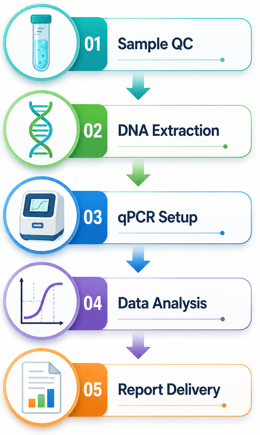
Our streamlined workflow is designed to ensure accurate, reproducible, and high-quality mitochondrial DNA (mtDNA) copy number quantification from sample receipt to final data delivery.
Step 1: Sample Receipt & Quality Assessment
Upon sample arrival, our team performs a comprehensive quality check to ensure suitability for downstream analysis.
Activities include:
• Receipt of blood, tissue, cultured cells, or purified genomic DNA (gDNA)
• Verification of sample labeling and documentation
• Inspection of sample integrity, packaging, and storage conditions
• DNA quality and quantity assessment using spectrophotometric and fluorometric methods
• Confirmation that DNA meets the required concentration and purity criteria for analysis
Step 2: DNA Extraction (If Required)
For samples requiring DNA isolation, genomic DNA is extracted using validated laboratory protocols optimized to preserve both mitochondrial and nuclear DNA.
Our workflow includes:
• High-quality DNA extraction using validated organic or column-based methods
• Optimization for consistent recovery of mitochondrial and nuclear DNA
• Quality assessment prior to qPCR analysis
Step 3: Duplex qPCR Assay
Purified DNA is analyzed using our optimized TaqMan Probe-Based Duplex qPCR Assay, which simultaneously quantifies mitochondrial DNA and a single-copy nuclear reference gene within the same reaction.
Quality measures include:
• Duplex amplification of mitochondrial and nuclear DNA targets
• Technical replicate analysis to ensure reproducibility
• Inclusion of positive controls, negative controls, and no-template controls in every assay run
• Strict adherence to validated qPCR protocols for consistent performance
Step 4: Data Quality Control & Bioinformatics Analysis
Following amplification, all data undergo comprehensive quality assessment and quantitative analysis using validated analytical workflows.
Analysis includes:
• Evaluation of replicate consistency and amplification performance
• Verification of assay specificity through quality-control metrics
• Calculation of relative or absolute mtDNA copy number using validated normalization methods
• Statistical review and generation of publication-ready quantitative results
Step 5: Comprehensive Reporting & Secure Data Delivery
Upon completion of the analysis, clients receive a detailed report containing quantitative results, quality metrics, and supporting documentation.
Deliverables include:
• Comprehensive PDF report with mtDNA copy number results
• Quality control summary and assay performance metrics
• Data visualizations and publication-ready figures
• Raw and processed data files
• Interpretation notes and analytical summary
• Secure online delivery of all project files through our protected data portal
Research Applications
Our Mitochondrial DNA (mtDNA) Copy Number Quantification Service supports a broad range of research applications by providing accurate and reproducible measurement of mitochondrial DNA abundance. This assay is widely used in basic research, translational studies, and drug development to investigate mitochondrial function, cellular metabolism, and disease mechanisms.
• Cancer Research
Quantify mitochondrial DNA copy number changes between tumor and matched normal tissues to investigate mitochondrial dysfunction, tumor progression, biomarker discovery, and therapeutic response in cancer research.
• Aging and Longevity Research
Monitor changes in mitochondrial DNA copy number associated with aging, cellular senescence, and longevity. The assay also supports studies evaluating the effects of dietary interventions, exercise, pharmaceuticals, and lifestyle modifications on mitochondrial health.
• Metabolic and Mitochondrial Disease Research
Investigate mtDNA copy number alterations associated with metabolic disorders such as diabetes, obesity, non-alcoholic fatty liver disease (NAFLD), and inherited mitochondrial diseases. The assay provides valuable insights into mitochondrial biogenesis, energy metabolism, and disease pathogenesis.
• Environmental and Occupational Health Studies
Assess the impact of environmental pollutants, radiation, heavy metals, industrial chemicals, and other toxic exposures on mitochondrial function by monitoring changes in mitochondrial DNA copy number.
• Pharmacology and Toxicology
Evaluate mitochondrial toxicity and cellular stress induced by drug candidates, biologics, and chemical compounds during preclinical research. mtDNA copy number analysis serves as an important biomarker for assessing mitochondrial safety and compound-induced cellular responses.
• Gene Editing and Functional Genomics
Measure the effects of gene-editing technologies, including CRISPR/Cas9, RNA interference (RNAi), and other functional genomics approaches on mitochondrial biology. The assay is also valuable for validating the impact of small molecules, genetic modifications, and targeted therapies on mitochondrial content and function.
• Biomarker Discovery and Translational Research
Support biomarker discovery studies by identifying mitochondrial DNA copy number changes associated with disease progression, therapeutic efficacy, and physiological responses. The generated data can be integrated with other genomic, transcriptomic, and proteomic datasets to provide comprehensive biological insights.
• Population and Clinical Research
Enable large-scale epidemiological and population-based studies investigating the relationship between mitochondrial DNA copy number and health outcomes, disease susceptibility, and environmental influences across diverse populations.
Why Choose N2Jenomics Lab Pvt. Ltd. for mtDNA Copy Number Quantification?
At N2Jenomics Lab Pvt. Ltd., we combine advanced molecular biology expertise with optimized qPCR workflows to deliver accurate, reproducible, and research-ready mitochondrial DNA (mtDNA) copy number analysis. Our commitment to quality, transparency, and scientific excellence ensures reliable results for academic, pharmaceutical, biotechnology, and CRO research projects.
• Scientific Accuracy and Reproducibility
Our mtDNA Copy Number Quantification service utilizes validated duplex TaqMan qPCR assays with carefully optimized primer and probe designs. Every assay undergoes stringent quality control, including amplification performance assessment, calibration standards, and comprehensive data validation to ensure accurate and reproducible results.
• Broad Sample Compatibility
Our optimized workflow supports a wide range of biological sample types, including:
- Whole blood
- Saliva
- Tissue specimens
- Cultured cells
- Purified genomic DNA (gDNA)
This flexibility enables consistent and reliable mtDNA-to-nuclear DNA ratio measurement across diverse research applications and experimental models.
• Comprehensive Data Reporting
We believe in complete transparency throughout the analytical process. Every project includes a detailed report containing:
- Quantified mtDNA copy number results
- Assay quality control metrics
- Amplification and performance summaries
- Raw and processed data files
- Normalized mtDNA-to-nuclear DNA ratios
- Publication-ready figures and data visualizations
- Interpretation notes to support downstream analysis
• Research and CRO-Ready Workflow
Our standardized laboratory procedures and validated analytical pipelines are designed to meet the demands of academic research, biotechnology companies, pharmaceutical organizations, and Contract Research Organizations (CROs). Whether your study focuses on biomarker discovery, drug development, mitochondrial biology, toxicology, or functional genomics, our workflow delivers dependable, high-quality data you can trust.
• Fast Turnaround and Dedicated Scientific Support
From project planning through final report delivery, our experienced scientists provide personalized technical guidance and responsive project management. We work closely with every client to optimize study design, ensure smooth project execution, and deliver timely, publication-ready results tailored to their research objectives.
• Trusted Partner for Mitochondrial Research
By integrating validated molecular assays, rigorous quality assurance, advanced data analysis, and dedicated scientific expertise, N2Jenomics Lab Pvt. Ltd. provides a dependable mtDNA Copy Number Quantification service that empowers researchers to generate accurate, reproducible, and biologically meaningful results with confidence.
Deliverables
Our Mitochondrial DNA (mtDNA) Copy Number Quantification Service provides comprehensive, research-ready deliverables designed to support downstream analysis, publication, and project documentation.
• Comprehensive Analytical Report
Receive a detailed PDF report summarizing the complete experimental workflow and assay performance. The report includes:
- Overview of the analytical methodology
- Assay workflow and reaction parameters
- Amplification performance and quality assessment
- Quantitative results and mtDNA copy number calculations
- Normalized mtDNA-to-nuclear DNA (mtDNA/nDNA) ratio
- Standard curve performance (where applicable)
- Data visualizations and publication-ready figures
- Quality control summary and interpretation notes
• Raw Data Files
To ensure complete transparency and facilitate independent analysis, we provide all relevant raw and processed data files, including:
- qPCR output files (.CSV and/or .XLSX)
- Cycle threshold (Ct/Cq) values
- Plate layout information
- Processed quantitative datasets suitable for downstream bioinformatics or statistical analysis
• Assay Performance Validation
Our reports include assay performance metrics demonstrating analytical reliability, including:
- Standard curve linearity and amplification efficiency (where applicable)
- Assay reproducibility
- Calibration and normalization information
- Validation of quantitative performance across the tested sample set
• Quality Assurance Metrics
Each project undergoes rigorous quality control before release. Quality metrics may include:
- Replicate consistency
- Assay precision and reproducibility
- Amplification quality assessment
- Sample quality evaluation
- Overall assay acceptance criteria
• Scientific Interpretation Summary
A concise interpretation accompanies the quantitative results, providing biological context and highlighting observed changes in mitochondrial DNA copy number relative to the experimental design or study controls. This summary is intended to support research interpretation and facilitate downstream analyses.
• Secure Data Delivery
All project deliverables are securely shared through our protected online data portal, ensuring confidential and convenient access to:
- Comprehensive PDF report
- Raw and processed data files
- Quality control documentation
- Supporting analytical outputs
Our secure delivery system enables clients to easily access, review, and download project data while maintaining data integrity and confidentiality throughout the process.
Sample Requirements
Sample Type
Required Format & Amount
Recommended DNA Input
Whole blood
EDTA/heparin tubes, 1–5 mL
≥ 5 ng per qPCR reaction
PBMCs
1–5×10⁶ cells, fresh or frozen
≥ 5 ng per reaction
Tissue (frozen/fresh)
≥ 10 mg (snap-frozen/RNAlater)
≥ 5 ng per reaction
Cultured cells
≥ 1×10⁶ cells
≥ 5 ng per reaction
Saliva / buccal swab
Collected in DNA-stabilizing buffer
≥ 5 ng per reaction
Urine / CSF / lavage
1–5 mL volume
Variable; aim ≥ 5 ng if possible
Purified gDNA
A260/280 ≈ 1.8–2.0; low fragmentation
≥ 0.1 ng per reaction
1. What is mitochondrial DNA (mtDNA) copy number?
Mitochondrial DNA copy number (mtDNA-CN) refers to the average number of mitochondrial genome copies present within a single cell. Since mitochondria are responsible for cellular energy production, mtDNA copy number serves as an important indicator of mitochondrial abundance, biogenesis, and overall cellular health. Changes in mtDNA-CN have been associated with a wide range of research areas, including cancer biology, aging, metabolic disorders, neurodegenerative diseases, and mitochondrial dysfunction.
2. Why is qPCR widely used for mtDNA copy number quantification?
Quantitative PCR (qPCR) is one of the most established methods for mtDNA copy number analysis because it combines high sensitivity, excellent reproducibility, rapid turnaround, and cost-effectiveness. By simultaneously measuring mitochondrial DNA and a single-copy nuclear reference gene, qPCR enables accurate estimation of the mtDNA-to-nuclear DNA ratio. Its scalability and high-throughput capability make it well suited for academic research, pharmaceutical development, and CRO-based studies.
3. How accurate is your mtDNA Copy Number Quantification assay?
Our assay is designed to deliver highly reproducible and reliable quantitative results through optimized laboratory procedures and stringent quality-control measures. Every analysis includes technical replicates, validated controls, and comprehensive data review to ensure assay consistency.
Key quality features include:
• Optimized duplex TaqMan qPCR workflow
• Technical replicate analysis for improved reproducibility
• Comprehensive assay quality control
• Standard curve validation (where applicable)
• Careful review of amplification performance and data consistency
• The overall accuracy of mtDNA copy number estimation depends on factors such as DNA quality, sample type, and experimental design.
4. What sample types are compatible with your assay?
Our mtDNA Copy Number Quantification service supports a wide variety of biological samples, including:
• Whole blood (EDTA)
• Peripheral blood mononuclear cells (PBMCs)
• Fresh or frozen tissue samples
• Cultured cells
• Saliva
• Urine
• Cerebrospinal fluid (CSF)
• Purified genomic DNA (gDNA)
• Each sample type is processed using optimized protocols to ensure high-quality DNA recovery and reliable mtDNA copy number measurement.
5. Can this assay be used for cancer research?
Yes. Mitochondrial DNA copy number analysis is widely used in cancer research to investigate mitochondrial alterations associated with tumor development, progression, and therapeutic response. Quantitative mtDNA-CN data can support studies focused on cancer biology, biomarker discovery, disease mechanisms, and translational oncology research.
6. How do you minimize interference from nuclear mitochondrial DNA sequences (NUMTs)?
Our assay has been carefully optimized to minimize amplification of nuclear mitochondrial DNA sequences (NUMTs). We employ validated primer and probe designs targeting conserved mitochondrial genomic regions while using a single-copy nuclear reference gene for normalization. In addition, multiple quality-control procedures—including assay validation, negative controls, and amplification performance assessment—help ensure highly specific and reliable mtDNA quantification.
7. Can fragmented or lower-quality DNA be analyzed?
High-quality DNA generally provides the most accurate and reproducible results. However, our optimized qPCR workflow can accommodate moderately fragmented DNA when sufficient target regions remain intact. Prior to analysis, each sample undergoes quality assessment to evaluate DNA concentration, purity, and suitability for testing. Samples that do not meet established quality criteria may require re-extraction or replacement to ensure dependable results.
8. How long does it take to receive results?
Turnaround time depends on the number of samples and project requirements. Most projects are completed within the agreed project timeline, and clients receive a comprehensive report along with raw data files, quality-control metrics, and supporting documentation through our secure online data portal.
9. Is this service intended for clinical diagnosis?
No. Our Mitochondrial DNA Copy Number Quantification service is provided exclusively for Research Use Only (RUO). The results are intended to support scientific research, biomarker discovery, drug development, and translational studies, and should not be used for clinical diagnosis, patient management, or therapeutic decision-making unless specifically validated under applicable regulatory requirements.
Address:Registered Office: 138, Patparganj Industrial Area, New Delhi – 110092, India
Operational Address: National Institute of Plant Genome Research (BRIC - NGGF)
Lab No. 206 and 207, Aruna Asaf Ali Marg, P.O. Box No. 10531,
New Delhi – 110067, India