Genome-wide association study (GWAS) Home  >  Population Genetics  > Genome-wide association study (GWAS)

Introduction to Genome-Wide Association Studies (GWAS)


Genome-Wide Association Studies (GWAS) are one of the most powerful genomic approaches for identifying genetic variants associated with complex traits and diseases. By analyzing millions of genetic markers across the genomes of large populations, GWAS enables researchers to uncover statistically significant associations between genetic variations and observable characteristics (phenotypes).

With advances in next-generation sequencing (NGS) and high-throughput genotyping technologies, GWAS has become an indispensable tool for understanding the genetic basis of complex diseases, agronomic traits, evolutionary biology, and population diversity.

GWAS has transformed modern genomics by accelerating gene discovery, supporting precision breeding, and enabling personalized medicine through the identification of genetic variants that influence health, disease susceptibility, and economically important traits.


What is the Purpose of GWAS


The primary goal of a Genome-Wide Association Study is to identify genetic variants associated with complex traits without requiring prior knowledge of candidate genes.

Unlike traditional family-based linkage studies, GWAS examines naturally occurring genetic variation across unrelated or diverse populations using high-density molecular markers such as Single Nucleotide Polymorphisms (SNPs).

By comparing genetic variation with phenotypic data, GWAS helps researchers identify genomic regions that contribute to complex biological traits, including disease susceptibility, productivity, stress tolerance, and developmental characteristics.


Key Objectives of GWAS

  •  

  • • Identify Trait-Associated Genetic Variants

  • GWAS aims to discover SNPs and other genetic markers that are significantly associated with specific traits or diseases. Identifying these variants helps researchers understand the genetic factors contributing to complex phenotypes and supports the development of improved diagnostic and breeding strategies.
  •  

  • • Understand the Genetic Architecture of Complex Traits

  • Most biological traits are influenced by multiple genes acting together. GWAS helps reveal how these genetic variants interact to regulate complex traits, providing valuable insights into the molecular mechanisms underlying biological processes.
  •  

  • • Enable Precision Medicine

  • By identifying genetic variants associated with disease risk, treatment response, and drug metabolism, GWAS contributes to the advancement of personalized medicine. These discoveries support individualized prevention strategies, diagnostics, and therapeutic interventions based on a person's genetic profile.
  •  

  • • Support Crop and Livestock Improvement

  • In agricultural genomics, GWAS identifies genomic regions associated with desirable traits such as yield, disease resistance, drought tolerance, nutritional quality, and stress adaptation. These findings accelerate marker-assisted breeding and genomic selection programs.
  •  

Advantages of GWAS


  • • Genome-Wide Analysis

  • GWAS evaluates genetic variation across the entire genome, enabling the discovery of novel loci associated with complex traits without restricting analysis to predefined candidate genes.
  •  
  • • High Throughput and Scalability

  • Modern sequencing and genotyping technologies allow millions of genetic variants to be analyzed simultaneously across hundreds or thousands of samples, significantly improving statistical power and discovery potential.
  •  

  • • Hypothesis-Free Discovery

  • Because GWAS does not rely on prior assumptions about gene function or genomic location, it enables the identification of previously unknown genes and biological pathways involved in complex traits.
  •  

  • • Reliable and Reproducible Results

  • Significant associations identified through GWAS can be independently validated in additional populations and supported by functional genomics studies, increasing confidence in the findings.


Applications of GWAS


  • • Disease Genetics

  • GWAS identifies genetic variants associated with complex diseases such as cancer, cardiovascular disorders, diabetes, autoimmune diseases, neurological disorders, and many other inherited or multifactorial conditions. These discoveries improve our understanding of disease mechanisms and facilitate the development of new therapeutic targets.
  •  
  • • Pharmacogenomics

  • GWAS helps identify genetic variants that influence individual responses to medications, supporting the development of personalized treatment strategies that improve drug efficacy while minimizing adverse effects.
  •  

  • • Agricultural Genomics

  • In crop and livestock research, GWAS is widely used to identify genes associated with economically important traits, including yield, flowering time, drought tolerance, disease resistance, nutritional quality, growth rate, and reproductive performance. These discoveries accelerate modern breeding programs and genomic selection.
  •  

  • • Population and Evolutionary Genetics

  • GWAS contributes to understanding genetic diversity, population structure, evolutionary history, and adaptation across different populations and species. It also helps explain how genetic variation influences trait diversity and disease susceptibility.


GWAS Workflow


GWAS involves selecting a study population, genotyping individuals to identify genetic variants, and then using statistical models to find associations between these variants and specific traits or diseases. The results are validated through replication in independent cohorts to confirm their reliability.


Service Specifications

Sample Requirements

  • Natural populations with reference genome ≥200;
    multiple minor loci-controlled trait populations ≥500
  • No obvious subgroup differentiation among samples
  • Strong heritability of the studied phenotypic traits
  • DNA sample: ~1.0 μg (concentration ≥ 10 ng/μl; OD260/280=1.8~2.0)
  • All DNA should be RNase-treated and should show no degradation or contamination.

Note: Sample amounts are listed for reference only. For detailed information, please contact us with your customized requests.


Sequencing Strategy

  • WGS: 10X/sample based on SNP; 30X/sample based on CNV
  • GBS: 10~20W Tags; average 8 X/Tag
  • Illumina Hiseq
  • Analysis of sequencing quality metrics

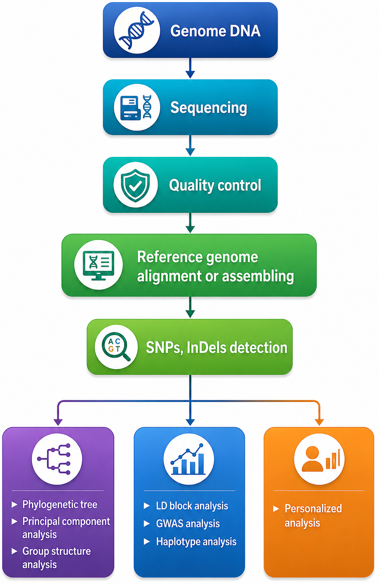
Bioinformatics Analysis
We provide multiple customized bioinformatics analyses:

  • Raw data QC
  • Reference alignment or assembling
  • LD decay distance analysis
  • PCA, structure, kinship analysis
  • GWAS analysis
  • LD block analysis
  • Personalized analysis

Note: Recommended data outputs and analysis contents displayed are for reference only. For detailed information, please contact us with your customized requests.

Analysis Pipeline


Deliverables

  •  
  • • Raw data (FASTQ)
  • • Significant SNP information
  • • QQ-plot and Manhattan plot
  • • Data analysis report

1. What are the key considerations for sample selection in a Genome-Wide Association Study (GWAS)?


Careful sample selection is essential for obtaining reliable and biologically meaningful GWAS results. The following principles should be considered:


Representative Sampling

Samples should accurately represent the target population to ensure that the study findings are broadly applicable and biologically relevant.


Minimize Population Stratification

Avoid selecting samples with significant population substructure or reproductive isolation, as genetic stratification can introduce confounding effects and increase false-positive associations.


Prioritize Highly Heritable Traits

Traits with high heritability are more likely to yield significant genetic associations. Selecting well-defined, heritable phenotypes improves the statistical power of the study.


Use Binary Phenotypes for Qualitative Traits

For qualitative traits, binary phenotypic classification (e.g., affected/unaffected or resistant/susceptible) is recommended. Ideally, both phenotype groups should contain similar numbers of individuals to maximize statistical reliability.


Collect Accurate Quantitative Phenotypes

Quantitative traits should be measured precisely using continuous variables whenever possible. For example, disease resistance can be evaluated using incidence rate, lesion count, lesion area, mortality rate, or survival percentage rather than subjective scoring scales. Well-distributed phenotypic data, preferably following a normal distribution, improves association analysis.


Perform Multi-Environment Phenotyping

For cultivated plants and breeding populations, conducting multi-year, multi-location, and replicated field trials improves phenotype accuracy. Data from individual environments or combined analyses can be used for GWAS.


Choose an Appropriate Sample Size

The required population size depends on the genetic architecture of the trait:

  • • Traits controlled by major genes: A minimum of 200 individuals is generally recommended.

  • • Complex polygenic traits: A larger population of 500 or more individuals is recommended to improve the detection of significant genetic associations.


2. Which types of populations can be used for GWAS?


Genome-Wide Association Studies can be performed using a wide range of natural and breeding populations, including:

  • • Natural populations
  • • Germplasm collections
  • • Mixed or half-sibling populations
  • • MAGIC (Multi-parent Advanced Generation Inter-Cross) populations
  • • NAM (Nested Association Mapping) populations
  • • Multiple F₂, Recombinant Inbred Line (RIL), or full-sibling populations
  • • F₁ populations of highly heterozygous species


The choice of population depends on the research objectives, species, and available genetic resources.


3. Can a single individual be evaluated for multiple traits in GWAS?


Yes. A single individual can be included in the analysis of multiple phenotypic traits simultaneously.

For example, the same individual may contribute data for plant height, flowering time, disease resistance, seed size, or other characteristics. Analyzing multiple traits within the same population is common practice and does not compromise the validity of GWAS results, provided each phenotype is measured accurately.


4. Can GWAS be performed without a reference genome?


Yes. GWAS can still be conducted in species lacking a reference genome by using reduced-representation sequencing approaches such as:

  • • Restriction-site Associated DNA Sequencing (RAD-seq)
  • • Genotyping-by-Sequencing (GBS)


These methods identify SNP markers through sequence clustering without requiring a reference genome.

However, while association analysis remains feasible, the absence of a reference genome limits downstream analyses such as:

  • • Candidate gene identification
  • • Functional annotation
  • • Genomic localization of associated variants


Whenever possible, the availability of a high-quality reference genome significantly enhances GWAS interpretation.


5. How are GWAS findings validated?


Significant genetic associations identified through GWAS should be validated using complementary approaches to confirm their biological relevance.

Common validation strategies include:

  •  
  • • Replication studies using independent populations or cohorts
  • • Candidate gene validation through molecular experiments
  • • Functional genomics analyses
  • • Gene expression studies (RNA-Seq or qRT-PCR)
  • • Pathway and gene network analyses
  • • Gene editing or transgenic validation (where applicable)
Address: Registered Office: 138, Patparganj Industrial Area, New Delhi – 110092, India
Email: info@n2jenomicslab.com
Phone: +91-8287121443 +91-9870548477
Operational Address: National Institute of Plant Genome Research (BRIC - NGGF) Lab No. 206 and 207, Aruna Asaf Ali Marg, P.O. Box No. 10531, New Delhi – 110067, India
Follow Us:
15,037 Total Visitors
Copyright © 2026 | All rights reserved N2Jenomics Lab Pvt Ltd