Plant/Animal Whole Genome de novo Sequencing
Home
>
Genomics Sequencing
> Plant/Animal Whole Genome de novo Sequencing
High-Resolution Genome Assembly for Plants and Animals
N2Jenomics Lab Pvt. Ltd. offers comprehensive Plant and Animal Whole Genome De Novo Sequencing services for accurate genome assembly without the need for a reference genome. By integrating Illumina, PacBio HiFi, Oxford Nanopore, and Hi-C technologies, we generate high-quality, chromosome-level genome assemblies with excellent accuracy and continuity. Our customized sequencing and bioinformatics solutions support research on crop plants, livestock, wildlife, and model organisms, delivering reliable, publication-ready genomic data.
What is Plant & Animal Whole Genome DeNovo Sequencing?
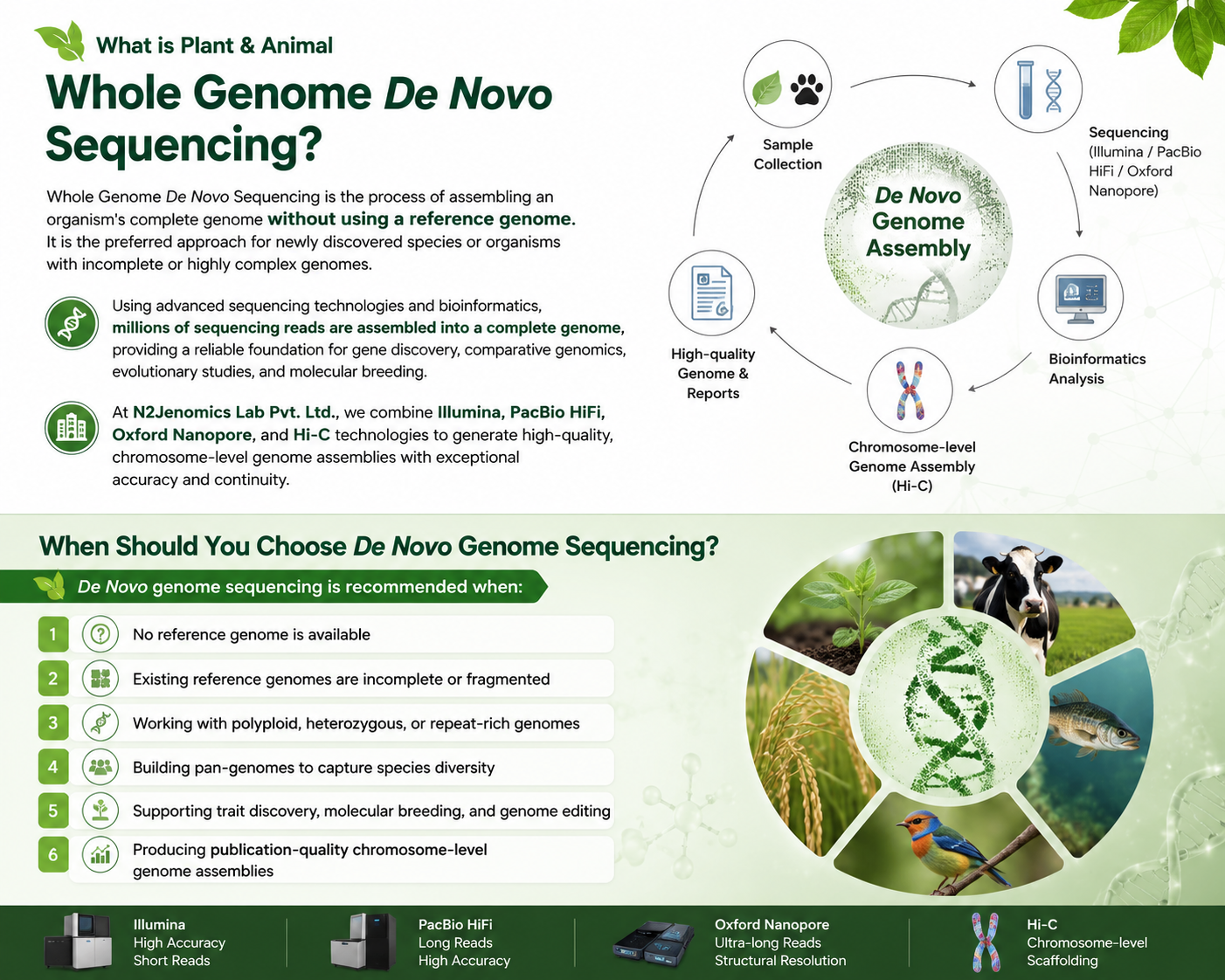
Whole Genome De Novo Sequencing is the process of assembling an organism's complete genome without using a reference genome. It is the preferred approach for newly discovered species or organisms with incomplete or highly complex genomes.
Using advanced sequencing technologies and bioinformatics, millions of sequencing reads are assembled into a complete genome, providing a reliable foundation for gene discovery, comparative genomics, evolutionary studies, and molecular breeding.
At N2Jenomics Lab Pvt. Ltd., we combine Illumina, PacBio HiFi, Oxford Nanopore, and Hi-C technologies to generate high-quality, chromosome-level genome assemblies with exceptional accuracy and continuity.
When Should You Choose DeNovo Genome Sequencing?
De Novo genome sequencing is recommended when:
• No reference genome is available
• Existing reference genomes are incomplete or fragmented
• Working with polyploid, heterozygous, or repeat-rich genomes
• Building pan-genomes to capture species diversity
• Supporting trait discovery, molecular breeding, and genome editing
• Chromosome-Level Scaffolding – Hi-C sequencing to order and orient contigs into chromosome-scale assemblies.
• Genome Annotation – RNA-Seq-based gene prediction and functional annotation.
Why Use Hi-C Sequencing?
Hi-C sequencing captures the three-dimensional organization of chromosomes, enabling accurate ordering and orientation of assembled contigs into chromosome-scale genomes. This technology significantly improves assembly quality, resolves complex genomic regions, and produces publication-ready genome assemblies.
Hybrid Sequencing Strategy
The best genome assemblies are achieved by combining short-read, long-read, and Hi-C sequencing technologies. At N2Jenomics Lab Pvt. Ltd., we design a customized sequencing strategy based on your organism's genome size, ploidy, complexity, and research objectives to ensure the highest assembly quality.
De Novo Genome Sequencing Workflow
Our end-to-end workflow delivers high-quality, chromosome-level genome assemblies from sample processing to final data analysis.
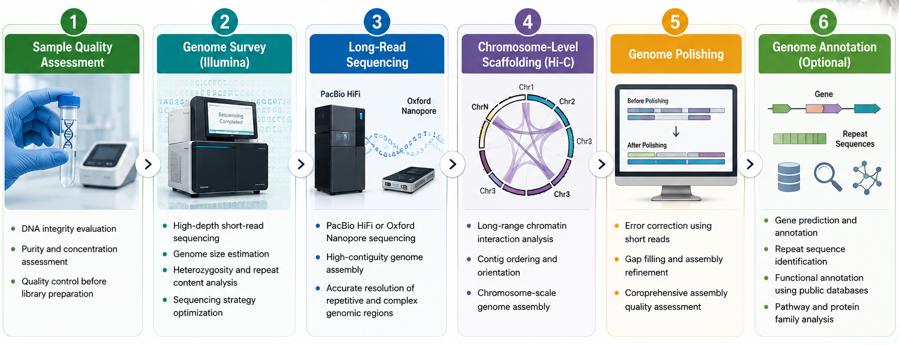
1. Sample Quality Assessment
• DNA integrity evaluation
• Purity and concentration assessment
• Quality control before library preparation
2. Genome Survey (Illumina)
• High-depth short-read sequencing
• Genome size estimation
• Heterozygosity and repeat content analysis
• Sequencing strategy optimization
3. Long-Read Sequencing
• PacBio HiFi or Oxford Nanopore sequencing
• High-contiguity genome assembly
• Accurate resolution of repetitive and complex genomic regions
4. Chromosome-Level Scaffolding (Hi-C)
• Long-range chromatin interaction analysis
• Contig ordering and orientation
• Chromosome-scale genome assembly
5. Genome Polishing
• Error correction using short reads
• Gap filling and assembly refinement
• Comprehensive assembly quality assessment
6. Genome Annotation (Optional)
• Gene prediction and annotation
• Repeat sequence identification
• Functional annotation using public databases
• Pathway and protein family analysis
Bioinformatics Analysis
Our comprehensive bioinformatics pipeline transforms raw sequencing data into biologically meaningful insights through:
• High-quality genome assembly
• Structural and functional genome annotation
• Repeat sequence analysis
• Comparative genomics
• Pan-genome analysis
• Population genomics
• Variant discovery and structural variation analysis
• Evolutionary and phylogenetic analysis
• Our workflows are optimized for diploid, polyploid, heterozygous, and repeat-rich plant and animal genomes, delivering accurate, publication-ready results.
Sample Requirements & Quality Standards
To ensure high-quality genome assemblies, we recommend the following sample requirements.
Sample Type
Minimum DNA Requirement
Quality Requirements
Animal tissue (fresh/frozen)
≥1.5 µg high-quality gDNA
High molecular weight DNA with minimal degradation
Plant leaves or stems
≥2.0 µg high-quality gDNA
Prefer young tissues with low polysaccharide and polyphenol content
Cultured cells
≥1.5 µg gDNA
High-quality DNA free from contaminants
Hi-C samples
Fresh tissue or cultured cells prepared using Hi-C protocol
Proper crosslinking required for chromosome conformation capture
General DNA Quality Criteria
• High molecular weight DNA (preferably >50 kb)
• DNA concentration ≥50 ng/µL
• Free from RNA, protein, and other contaminants
• DNA integrity confirmed using standard quality assessment methods
DNA Extraction Support
N2Jenomics Lab Pvt. Ltd. provides complete DNA extraction and quality assessment services for both plant and animal samples. Our optimized protocols generate high-molecular-weight DNA suitable for long-read sequencing and chromosome-level genome assembly.
Project Deliverables
Every project includes comprehensive data and analysis files to support downstream research and publication.
• Standard Deliverables
- Raw sequencing data (FASTQ)
- Assembled genome sequences (FASTA)
- Assembly quality and statistics report
- Genome annotation files (optional)
- Hi-C interaction maps (if applicable)
- Genome visualization (Circos and synteny plots)
- Comprehensive bioinformatics analysis report
• Optional Analysis Services
Enhance your project with advanced analytical solutions, including:
- Chromosome-level genome assembly
- Functional genome annotation
- Comparative genomics analysis
- Pan-genome construction
- Structural variant analysis
- Epigenomics integration
- GWAS-ready SNP and INDEL datasets
1. What is Plant or Animal Whole Genome De Novo Sequencing?
Whole Genome De Novo Sequencing is a reference-free approach that reconstructs an organism's complete genome from scratch. It is ideal for species without a reference genome or those with highly complex genomic structures.
2. When should I choose De Novo Sequencing instead of Resequencing?
De Novo sequencing is recommended when:
• No high-quality reference genome is available.
• The genome is highly repetitive, heterozygous, or polyploid.
• You want to build a new reference genome or pan-genome.
• A chromosome-level genome assembly is required.
3. Which sequencing technologies do you use?
We use an integrated multi-platform approach that may include:
• Illumina for genome survey and error correction
• PacBio HiFi or Oxford Nanopore for long-read genome assembly
• Hi-C Sequencing for chromosome-level scaffolding
The optimal platform combination is selected based on your genome characteristics and research objectives.
4. What sample quality is required?
High-quality, high-molecular-weight genomic DNA is recommended for optimal results. Key requirements include:
Operational Address: National Institute of Plant Genome Research (BRIC - NGGF)
Lab No. 206 and 207, Aruna Asaf Ali Marg, P.O. Box No. 10531,
New Delhi – 110067, India