Advanced Single-cell RNA Sequencing Services for High-Resolution Transcriptome Profiling
N2Jenomics Lab Pvt. Ltd. offers end-to-end Single-Cell RNA Sequencing (scRNA-seq) services that enable researchers to investigate gene expression at true single-cell resolution. Our integrated workflow covers sample quality assessment, single-cell library preparation, high-throughput sequencing, advanced bioinformatics, and biological interpretation, helping researchers uncover cellular diversity within complex tissues.
Whether your research focuses on cancer biology, immunology, neuroscience, developmental biology, or precision medicine, our scRNA-seq platform provides the resolution needed to identify rare cell populations, characterize cellular states, and explore transcriptional heterogeneity with confidence.
Why Choose N2Jenomics Lab Pvt. Ltd. for Single-Cell RNA Sequencing?
Our single-cell RNA sequencing service is designed to deliver reliable data generation, scalable experimental workflows, and comprehensive downstream analysis tailored to your research objectives.
• Scalable Experimental Design
Our workflows support projects ranging from hundreds to thousands of individual cells per sample, making them suitable for both pilot studies and large-scale transcriptomic investigations.
• Efficient Sample Multiplexing
Optimized multiplexing strategies enable simultaneous processing of multiple samples within a single experiment, improving throughput while maintaining data quality and reducing technical variation.
• High-Performance Cell Capture
Our workflows utilize industry-leading single-cell technologies that provide high cell recovery rates and efficient transcript capture, maximizing the number of high-quality cells available for downstream analysis.
• Comprehensive Bioinformatics Analysis
Beyond sequencing, our dedicated bioinformatics team provides advanced analyses, including:
- Cell clustering and visualization.
- Cell type identification and annotation.
- Differential gene expression analysis.
- Cell trajectory and pseudotime analysis.
- Cell–cell communication analysis.
- Functional enrichment and pathway analysis.
- Publication-ready figures and comprehensive reports.
• Rigorous Quality Control
Quality is monitored throughout every stage of the workflow—from sample evaluation and library preparation to sequencing and data analysis—to ensure reliable, reproducible, and high-quality results.
• Customized Research Solutions
Every project is tailored to the specific biological question, sample type, species, and experimental design, providing flexible solutions for diverse research applications.
High-Resolution Transcriptome Profiling at Single-Cell Resolution
N2Jenomics Lab Pvt. Ltd. offers comprehensive Single-Cell RNA Sequencing (scRNA-seq) services that enable researchers to investigate gene expression with true single-cell resolution. From sample quality assessment and library preparation to high-throughput sequencing and advanced bioinformatics, our end-to-end workflow delivers reliable insights into cellular diversity, transcriptional dynamics, and tissue complexity.
Our scRNA-seq solutions are designed for high-quality samples with low-input requirements, allowing researchers to study transcriptomes from individual cells, rare cell populations, and complex biological specimens. By combining cutting-edge library preparation technologies with Illumina sequencing platforms and robust bioinformatics, we generate high-quality, publication-ready data that supports discoveries across cancer research, immunology, neuroscience, developmental biology, and precision medicine.
What is Single-Cell RNA Sequencing (scRNA-seq)?
Cells are the fundamental building blocks of life, yet even cells within the same tissue can differ significantly in their gene expression, function, and biological behavior. Traditional bulk RNA sequencing measures the average transcriptome of mixed cell populations, masking important differences between individual cells.
Single-Cell RNA Sequencing (scRNA-seq) overcomes this limitation by profiling the transcriptome of individual cells. This powerful technology enables researchers to analyze gene expression patterns cell by cell, revealing cellular heterogeneity, identifying rare cell populations, and uncovering molecular mechanisms that drive development, disease progression, and therapeutic response.
With scRNA-seq, researchers can:
• Profile gene expression at single-cell resolution.
• Characterize heterogeneous cell populations.
• Identify novel and rare cell types.
• Explore cellular differentiation and developmental trajectories.
• Investigate cell-state transitions and lineage relationships.
• Study complex biological systems with unprecedented resolution.
Our Single-Cell RNA Sequencing Platform
At N2Jenomics Lab Pvt. Ltd., we provide complete scRNA-seq solutions using industry-leading sequencing technologies and optimized laboratory workflows.
Our services include:
• Sample quality assessment.
• Single-cell isolation and capture.
• Library preparation for low-input RNA.
• High-throughput Illumina sequencing.
• Comprehensive bioinformatics analysis.
• Publication-ready data visualization and reporting.
Our integrated workflow delivers accurate and reproducible transcriptomic profiles suitable for both exploratory and hypothesis-driven research.
Advantages of Single-Cell RNA Sequencing
• Exceptional Sensitivity
Detect low-abundance transcripts and rare gene expression events that may be overlooked by conventional bulk RNA sequencing.
• Single-Cell Resolution
Measure gene expression in individual cells to reveal subtle biological differences, cellular diversity, and dynamic transcriptional changes.
• High-Throughput Analysis
Profile thousands to tens of thousands of cells simultaneously, enabling comprehensive characterization of complex tissues and biological systems.
• Comprehensive Cellular Insights
Gain a deeper understanding of cellular identity, function, signaling pathways, and molecular mechanisms through detailed transcriptome analysis.
• Discovery of Novel Cell Types
Identify previously unrecognized cell populations, biomarkers, and disease-associated cellular states that contribute to biological complexity.
• Broad Research Applications
Our scRNA-seq platform supports a wide range of sample types and research areas, including tissues, organoids, embryos, tumors, cultured cells, and clinical specimens.
Applications of Single-Cell RNA Sequencing
• Cancer Research
Single-cell transcriptomics enables detailed characterization of tumor ecosystems and cellular diversity.
Applications include:
- Tumor heterogeneity analysis.
- Characterization of the tumor microenvironment.
- Clonal evolution studies.
- Biomarker discovery.
- Investigation of therapeutic resistance.
• Immunology
Analyze immune cell populations and immune responses at single-cell resolution.
Applications include:
- Immune cell profiling.
- Characterization of immune activation states.
- Studies of inflammation and autoimmune diseases.
- Vaccine and infectious disease research.
- Cell–cell interaction analysis.
• Stem Cell & Regenerative Biology
Investigate cellular differentiation and lineage commitment during development and tissue regeneration.
Applications include:
- Stem cell characterization.
- Lineage tracing.
- Cell fate determination.
- Regenerative medicine research.
- Tissue development studies.
• Neuroscience
Explore the molecular diversity of the nervous system through high-resolution transcriptomic profiling.
Applications include:
- Neuronal and glial cell characterization.
- Neural development studies.
- Brain cell atlas generation.
- Neurodegenerative disease research.
- Neurological disorder investigations.
• Developmental Biology
Understand how complex tissues and organs develop from individual cells.
Applications include:
- Embryonic development.
- Tissue morphogenesis.
- Developmental gene regulation.
- Congenital disease research.
- Cellular differentiation analysis.
• Precision Medicine
Support translational research through comprehensive cellular profiling.
Applications include:
- Biomarker discovery.
- Patient stratification.
- Therapeutic target identification.
- Drug response prediction.
- Clinical research.
• scRNA-seq Bioinformatics Analysis
Every project includes a comprehensive bioinformatics workflow designed to transform raw sequencing data into biologically meaningful insights.
Our analysis pipeline includes:
- Sequencing quality assessment.
- Read alignment and transcript quantification.
- Cell barcode and UMI processing.
- Cell clustering and visualization.
- Cell type annotation.
- Differential gene expression analysis.
- Cell trajectory and pseudotime analysis.
- Cell–cell communication analysis.
- Gene Ontology (GO) enrichment analysis.
- KEGG pathway analysis.
- Publication-ready figures and comprehensive reports.
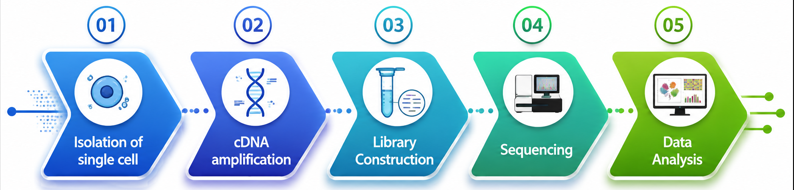
Single-Cell RNA Sequencing Workflow
Our standardized workflow ensures high-quality data generation and reproducible biological insights through rigorous quality control at every stage.
Step 1: Sample Preparation
• Tissue dissociation or cell suspension preparation.
• Cell viability assessment.
• Sample quality control.
Step 2: Single-Cell Capture
• Isolation of individual cells using advanced cell partitioning technologies.
• Cell barcoding and molecular indexing.
• Single-cell encapsulation.
Step 3: Library Preparation
• Cell lysis and RNA capture.
• Reverse transcription and cDNA synthesis.
• Library construction.
• Library quality assessment.
Step 4: Next-Generation Sequencing
• High-throughput sequencing using Illumina platforms.
• Generation of high-quality transcriptomic data.
Step 5: Bioinformatics Analysis
• Data preprocessing and quality filtering.
• Transcript quantification.
• Cell clustering and annotation.
• Differential expression analysis.
• Functional enrichment analysis.
• Biological interpretation and visualization.
Single-Cell RNA Sequencing Technologies
At N2Jenomics Lab Pvt. Ltd., we employ advanced single-cell library preparation technologies to support diverse research applications, from targeted transcriptome profiling to full-length RNA sequencing. Our optimized workflows are designed to deliver high-quality, reproducible data from individual cells and ultra-low RNA input samples, ensuring reliable results for both basic and translational research.
Fluidigm C1 Single-Cell mRNA Workflow
The Fluidigm C1 Single-Cell System is a microfluidics-based platform that enables automated isolation, processing, and transcriptome profiling of individual cells. By integrating cell capture, cDNA synthesis, and amplification into a streamlined workflow, the system minimizes manual handling while ensuring consistent sample processing and high-quality sequencing libraries.
The platform utilizes Integrated Fluidic Circuits (IFCs) to efficiently capture single cells, convert polyadenylated (polyA+) RNA into full-length cDNA, and perform universal cDNA amplification for downstream sequencing.
Key Features
• Automated single-cell capture using microfluidic technology.
• Full-length cDNA synthesis from individual cells.
• Integrated library preparation workflow.
• High reproducibility with minimal hands-on processing.
• Flexible experimental design for diverse cell types.
Applications
The Fluidigm C1 workflow supports a wide range of single-cell genomics applications, including:
• Single-cell transcriptome profiling.
• Full-length mRNA sequencing.
• 3′ gene expression analysis.
• DNA sequencing.
• Epigenetic studies.
• microRNA expression profiling.
• Cell population characterization and biomarker discovery.
SMART-seq Ultra-Low Input RNA Sequencing
SMART-seq is a highly sensitive full-length transcriptome sequencing technology designed for individual cells and ultra-low RNA input samples. It captures complete transcript sequences, enabling detailed analysis of transcript structure and gene expression with excellent sensitivity and reproducibility.
Unlike 3′ counting approaches, SMART-seq generates full-length cDNA, allowing researchers to investigate transcript complexity and sequence-level variations.
Key Features
• Full-length transcript coverage.
• Compatible with single cells and ultra-low RNA input.
• Highly reproducible cDNA synthesis.
• Accurate representation of GC-rich transcripts.
• Compatible with Illumina sequencing platforms.
Applications
SMART-seq is particularly well suited for studies requiring comprehensive transcript information, including:
• Gene expression profiling.
• Alternative splicing analysis.
• Transcript isoform identification.
• Gene fusion detection.
• Single nucleotide variant (SNV) analysis.
• Low-input RNA sequencing.
• Rare cell transcriptomics.
Choosing the Right Technology
Both Fluidigm C1 and SMART-seq provide powerful solutions for single-cell transcriptomics, but each is optimized for different research objectives.
Feature
Fluidigm C1
SMART-seq
Primary Workflow
Automated microfluidic single-cell capture
Full-length transcript sequencing
Sample Type
Individual cells
Single cells or ultra-low RNA input
Transcript Coverage
Full-length transcripts
Full-length transcripts
Automation
High
Library preparation workflow
Best Applications
Single-cell transcriptomics, cell population studies, multi-omics
Note: Recommended data outputs and analysis contents displayed are for reference only. For detailed information, please contact us with your customized requests.
Analysis Pipeline
Deliverables
• The original sequencing data
• Experimental results
• Data analysis report
• Details in Single-cell RNA Sequencing for your writing (customization)
1. What is the purpose of Single-Cell RNA Sequencing (scRNA-seq)?
Single-Cell RNA Sequencing (scRNA-seq) is designed to analyze gene expression at the resolution of individual cells, providing insights that cannot be achieved with conventional bulk RNA sequencing. By examining each cell independently, scRNA-seq reveals cellular diversity, identifies rare cell populations, and uncovers functional differences within complex tissues.
This technology is widely used to:
• Characterize cellular heterogeneity.
• Identify novel and rare cell types.
• Investigate developmental and differentiation processes.
• Study cell-specific responses to disease and therapeutic interventions.
• Understand the molecular composition of complex biological systems.
2. What is the difference between RNA-Seq and scRNA-seq?
Although both techniques analyze gene expression, they differ significantly in their resolution and applications.
RNA-Seq (Bulk RNA Sequencing)
Single-Cell RNA Sequencing (scRNA-seq)
Measures the average gene expression across a population of cells.
Profiles gene expression in individual cells.
Requires RNA extracted from many cells.
Can analyze thousands of individual cells simultaneously.
Cannot distinguish differences between cell types within a mixed sample.
Reveals cellular heterogeneity and rare cell populations.
Best suited for overall tissue-level expression analysis.
Ideal for studying cell-specific biology, developmental trajectories, and complex tissues.
By providing transcriptomic information at single-cell resolution, scRNA-seq enables researchers to uncover biological complexity that is often masked in bulk RNA sequencing experiments.
3. What is pseudotime analysis in scRNA-seq?
Pseudotime analysis is a computational approach used to reconstruct dynamic biological processes, such as cell differentiation and development, from single-cell transcriptomic data.
Since cells collected from the same sample often represent different stages of a biological process, pseudotime algorithms arrange individual cells along an inferred developmental trajectory based on similarities in their gene expression profiles.
Pseudotime analysis helps researchers to:
• Reconstruct cellular differentiation pathways.
• Identify transitional cell states.
• Discover lineage relationships.
• Investigate developmental progression.
• Explore gene expression changes over time.
• Reveal key regulatory genes involved in biological processes.
This approach is particularly valuable in developmental biology, stem cell research, cancer evolution, and regenerative medicine.
4. How are cell types identified in single-cell RNA sequencing data?
Cell type annotation is one of the most important steps in scRNA-seq analysis. Researchers typically combine multiple analytical approaches to accurately identify and classify cell populations.
A. Marker Gene-Based Cell Annotation
Known marker genes provide a reliable method for identifying specific cell types.
Examples include:
• CD3D, CD3E, and CD4 for T lymphocytes.
• CD19 and CD20 (MS4A1) for B lymphocytes.
• EPCAM for epithelial cells.
• PECAM1 (CD31) for endothelial cells.
• COL1A1 for fibroblasts.
Specialized visualization software and bioinformatics tools can map the expression of these markers across cell clusters to assign cellular identities.
B. Differential Gene Expression Analysis
Single-cell analysis pipelines identify genes that are significantly enriched within each cluster. These cluster-specific marker genes are then compared with published reference datasets and cell marker databases to determine the most likely cell identity.
Common analysis tools include:
• Cell Ranger.
• Seurat.
• Monocle.
• Scanpy.
• Loupe Browser.
C. Functional Pathway Analysis
When well-established marker genes are unavailable or inconclusive, researchers can infer cell identity by examining the biological functions associated with differentially expressed genes.
Functional annotation commonly includes:
• Gene Ontology (GO) enrichment analysis.
• Kyoto Encyclopedia of Genes and Genomes (KEGG) pathway analysis.
• Reactome pathway analysis.
• Gene Set Enrichment Analysis (GSEA).
These approaches provide insights into the biological roles of each cell cluster and help identify previously uncharacterized cell populations.
5. What bioinformatics analyses are included in scRNA-seq data analysis?
A comprehensive scRNA-seq analysis workflow typically includes:
• Raw sequencing quality assessment.
• Read alignment and transcript quantification.
• Cell barcode and UMI processing.
• Cell filtering and quality control.
• Dimensionality reduction (PCA, UMAP, t-SNE).
• Cell clustering.
• Cell type annotation.
• Differential gene expression analysis.
• Pseudotime and trajectory analysis.
• Cell–cell communication analysis.
• GO and KEGG pathway enrichment.
• Publication-ready visualizations and detailed reports.
6. What types of samples are suitable for scRNA-seq?
Single-cell RNA sequencing can be performed on a wide variety of biological samples, provided that high-quality, viable single-cell suspensions can be obtained.
Common sample types include:
Fresh tissues.
Cultured cells.
Peripheral blood mononuclear cells (PBMCs).
Tumor tissues.
Stem cells.
Embryonic tissues.
Immune cells.
Organoids.
Clinical research specimens.
Proper sample preparation and high cell viability are essential for generating high-quality single-cell transcriptomic data.
Operational Address: National Institute of Plant Genome Research (BRIC - NGGF)
Lab No. 206 and 207, Aruna Asaf Ali Marg, P.O. Box No. 10531,
New Delhi – 110067, India