Unlock insights into protein translation with N2Jenomics Lab Pvt. Ltd.'s comprehensive Ribosome Profiling (Ribo-seq) services. Our end-to-end workflow covers ribosome-protected fragment (RPF) library preparation, high-throughput sequencing, and advanced bioinformatics analysis to accurately profile active translation at genome-wide resolution.
Our flexible solutions help researchers investigate translation efficiency, translational regulation, ribosome dynamics, and protein synthesis mechanisms across diverse biological systems.
Key Features
• Comprehensive Ribo-seq workflow from RPF enrichment to bioinformatics analysis
• Translation efficiency (TE) analysis across different biological conditions
• Identification of translation initiation sites, upstream ORFs (uORFs), and small ORFs (sORFs)
• High-resolution ribosome occupancy analysis with P-site assignment and 3-nt periodicity quality assessment
• Detection of ribosome stalling, pausing, and translational frameshifts
• Integrated RNA-seq and Ribo-seq analysis to distinguish transcriptional and translational regulation
• Functional interpretation through GO, KEGG, and pathway enrichment analyses
• High-quality research-use-only (RUO) data supported by rigorous quality control and expert bioinformatics
N2Jenomics Lab Pvt. Ltd. provides comprehensive Ribosome Profiling (Ribo-seq) services that combine optimized laboratory workflows with advanced bioinformatics to deliver reliable, reproducible, and publication-ready results. Our end-to-end solutions support studies of translational regulation, protein synthesis, and gene expression with codon-level resolution.
Our Advantages
• End-to-end Ribo-seq service from sample preparation to bioinformatics analysis
• Comprehensive quality control, including 3-nt periodicity, P-site assignment, metagene profiling, and replicate assessment
• Advanced translation efficiency (TE) analysis with optional integration of matched RNA-seq data
• Identification of uORFs, sORFs, ribosome stalling, and codon usage patterns
• Flexible workflows for complete projects or bioinformatics analysis of existing sequencing data
• Support for diverse sample types, including cultured cells, tissues, bacteria, and non-model organisms
• Publication-ready reports, figures, and data files
• Experienced scientific support for experimental design, quality assessment, and data interpretation
What Is Ribosome Profiling (Ribo-seq)?
Ribosome Profiling (Ribo-seq) is a next-generation sequencing technique that captures ribosome-protected mRNA fragments (RPFs) to provide a genome-wide snapshot of active protein translation. By sequencing these protected fragments, researchers can determine which transcripts are being translated and precisely locate ribosomes along coding regions.
Ribo-seq enables high-resolution analysis of translational regulation that cannot be obtained from RNA sequencing alone.
Why Use Ribo-seq?
Ribo-seq enables researchers to:
• Measure translation efficiency (TE) across different biological conditions
• Distinguish transcriptional changes from translational regulation
• Identify translation initiation sites, upstream ORFs (uORFs), and small ORFs (sORFs)
• Detect ribosome pausing, stalling, and translational frameshifts
• Analyze codon occupancy and translation dynamics
• Integrate results with GO, KEGG, and pathway enrichment analyses for biological interpretation
Ribo-seq Workflow
1. Sample Preparation
Translation is stabilized, followed by RNase digestion to isolate ribosome-protected RNA fragments.
2. Library Preparation
rRNA depletion, fragment size selection, adapter ligation, reverse transcription, PCR amplification, and library quality assessment.
3. High-Throughput Sequencing
Sequencing is performed on Illumina short-read platforms to generate high-quality ribosome footprint data.
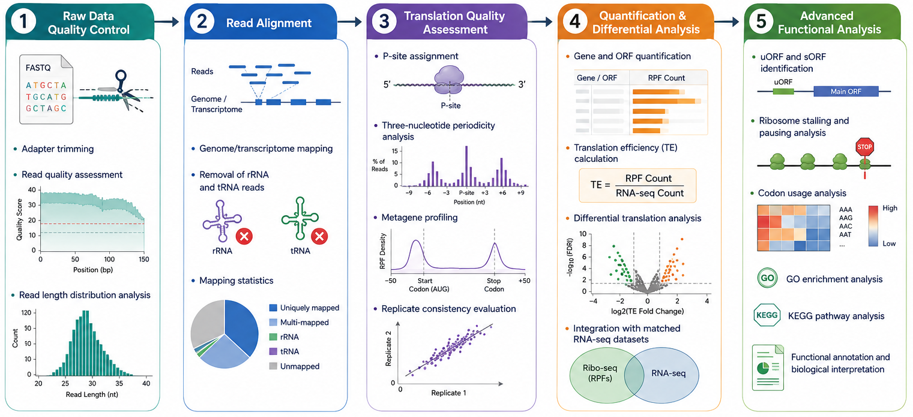
4. Bioinformatics Analysis
Comprehensive downstream analysis includes translation efficiency, ribosome occupancy, differential translation, and functional interpretation.
- Functional annotation and biological interpretation
Ribo-seq and Multi-omics Integration Analysis
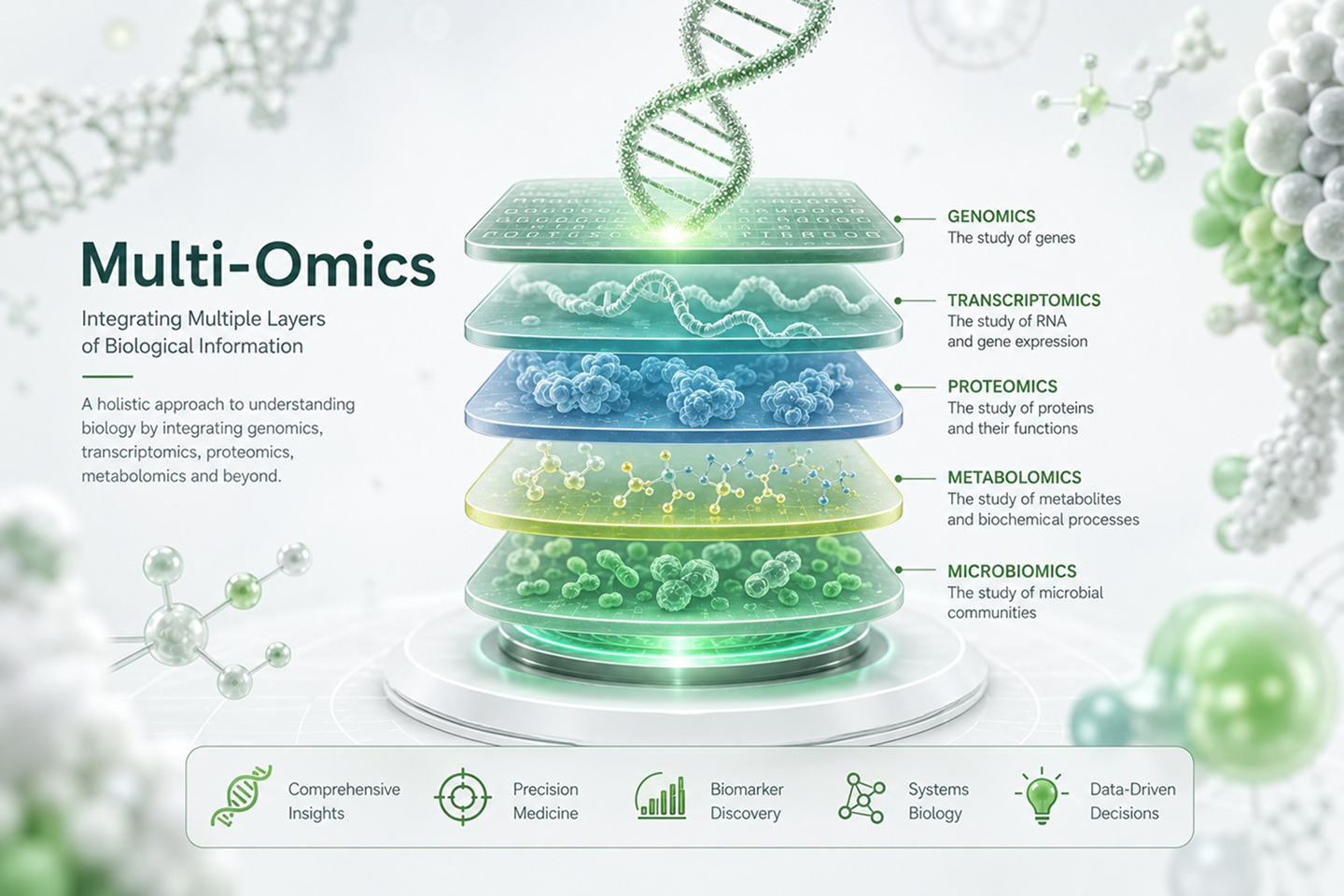
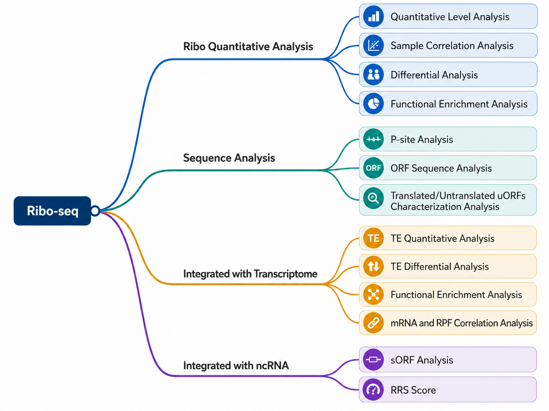
Our comprehensive Ribo-seq bioinformatics pipeline transforms ribosome footprint sequencing data into biologically meaningful insights. By integrating Ribo-seq with RNA-seq, we enable researchers to distinguish transcriptional regulation from translational control and gain a deeper understanding of protein synthesis.
• Quantitative Translation Analysis
- Gene and ORF expression quantification
- Data normalization and differential translation analysis
- Replicate correlation assessment and outlier detection
• Codon-Level Translation Analysis
- P-site assignment and metagene profiling
- Three-nucleotide periodicity evaluation
- Identification of upstream ORFs (uORFs) and small ORFs (sORFs)
• Integrated Multi-omics Analysis
- Translation efficiency (TE) calculation using matched RNA-seq data
- Differential translation efficiency analysis
- Identification of concordant and discordant transcriptional and translational changes
• Advanced Functional Interpretation
- Ribosome stalling and pausing analysis
- Codon usage profiling
- GO enrichment analysis
- KEGG pathway analysis
- Functional annotation and biological interpretation
Quality Assurance & Experimental Design
Our standardized workflows ensure high-quality, reproducible, and traceable Ribo-seq data.
• Experimental Design Support
- Assistance with study design and experimental comparisons
- Recommendation of at least three biological replicates per experimental group
- Optional matched RNA-seq for robust translation efficiency analysis
• Quality Control Metrics
- Three-nucleotide periodicity assessment
- Accurate P-site offset determination
- Ribosome footprint length distribution analysis
- Mapping statistics and residual rRNA/tRNA evaluation
- Replicate concordance and outlier identification
• Data Traceability
- Complete sequencing and laboratory metadata
- Version-controlled bioinformatics workflows
- Comprehensive analysis records for reproducibility
Deliverables
Our Ribo-seq service includes a complete set of sequencing data, analytical results, and publication-ready reports.
• Raw Data
- FASTQ files
- BAM alignment files (optional)
- Sample metadata and sequencing information
• Quality Control Reports
- Read quality assessment
- Mapping statistics
- Residual rRNA/tRNA analysis
- Ribosome footprint length distribution
- P-site metagene profiles
- Three-nucleotide periodicity plots
- Replicate correlation analysis
• Bioinformatics Results
- Gene and ORF count tables
- Translation efficiency (TE) analysis
vDifferential translation analysis
- uORF and sORF identification
- Ribosome stalling analysis
- Codon usage analysis
- GO and KEGG enrichment analysis
• Final Report
- Comprehensive PDF report
- Publication-quality figures (PNG/SVG)
- Editable data tables (CSV/TSV)
- Biological interpretation and analysis summary
Sample Requirements
Sample Type
Minimum Input
Recommended Input
Cultured Cells
≥ 4 × 10⁷ cells
Low-input projects available upon review
Animal or Plant Tissue
≥ 400 mg
~3 g preferred
Bacterial Cells
≥ 4 × 10⁷ cells
Higher input recommended for optimal results
Purified Ribosome-Protected Fragments (RPFs)
≥ 200 ng/µL, ≥10 µL
Ready for library preparation
Sample requirements may vary depending on project objectives and sample quality. Please contact us for customized recommendations.
Applications of Ribo-seq
Ribosome Profiling is widely applied in both basic and translational research to investigate protein synthesis and translational regulation.
• Drug Discovery & Mechanism of Action
Evaluate translation-level responses to drug treatment and identify affected biological pathways.
• Target Validation & Biomarker Discovery
Prioritize therapeutic targets by correlating translation efficiency with protein production and identifying translational biomarkers.
• Drug Resistance Research
Characterize translational reprogramming, ribosome pausing, and adaptive responses associated with therapeutic resistance.
• Immunology Research
Investigate translational regulation of immune-related genes and cellular responses under different physiological conditions.
• Virology
Analyze viral translation, frameshifting events, and host-virus interactions at codon-level resolution.
• Plant & Agricultural Research
Study stress-responsive translation, uORF-mediated regulation, and translational mechanisms influencing crop performance.
1. What is the difference between Ribo-seq and RNA-seq?
Ribo-seq measures actively translated RNA by sequencing ribosome-protected fragments (RPFs), providing insights into protein synthesis and translation efficiency (TE). In contrast, RNA-seq measures the abundance of RNA transcripts. Combining both techniques helps distinguish transcriptional regulation from translational control.
2. What is an ORF, and what can Ribo-seq detect?
An open reading frame (ORF) is a sequence of nucleotides that can be translated into a protein, beginning with a start codon and ending with a stop codon. Ribo-seq can identify translated ORFs, including upstream ORFs (uORFs), small ORFs (sORFs), and translation events within coding and non-coding RNAs.
3. How is a Ribo-seq experiment performed?
A typical Ribo-seq workflow includes:
• Stabilization of ribosomes on mRNA
• RNase digestion to isolate ribosome-protected fragments
• rRNA depletion and fragment size selection
• Library preparation and high-throughput sequencing
• Bioinformatics analysis, including read alignment, P-site assignment, translation efficiency analysis, differential translation analysis, and functional annotation
4. What deliverables are included with the Ribo-seq service?
Our standard deliverables include:
• Raw sequencing data (FASTQ; BAM files available upon request)
• Quality control reports
• Gene and ORF quantification tables
• Translation efficiency and differential translation analyses
• uORF/sORF identification
• Ribosome stalling analysis
• GO and KEGG pathway enrichment results
• A comprehensive bioinformatics report with publication-ready figures and tables
5. Is matched RNA-seq required for translation efficiency analysis?
Matched RNA-seq data is highly recommended for accurate translation efficiency (TE) analysis. Integrating Ribo-seq with RNA-seq enables researchers to determine whether changes in gene expression occur at the transcriptional or translational level.
6. How is the quality of a Ribo-seq library evaluated?
High-quality Ribo-seq libraries typically exhibit:
• Strong three-nucleotide (3-nt) periodicity
• Accurate P-site assignment
• Expected ribosome-protected fragment length distribution
• High mapping rates
• Good agreement between biological replicates
7. What are the limitations of Ribo-seq?
Although Ribo-seq provides detailed insights into protein translation, some limitations include:
• Residual rRNA contamination may reduce sequencing efficiency.
• Short ribosome footprints can complicate ORF identification.
• Translation efficiency estimates do not directly measure protein abundance.
• Standard protocols generally require relatively high-quality and sufficient input material.
8. What sample types are supported?
Our Ribo-seq workflow supports a variety of sample types, including:
• Cultured cells
• Animal and plant tissues
• Bacterial samples
• Purified ribosome-protected fragments (RPFs)
We support commonly studied model organisms and can evaluate non-model species for project feasibility.
9. Do you offer bioinformatics analysis for existing Ribo-seq data?
Yes. In addition to complete experimental services, we provide analysis-only solutions for existing Ribo-seq datasets. We can analyze purified RPF libraries or raw sequencing data using a customizable bioinformatics pipeline tailored to your research objectives.
Address:Registered Office: 138, Patparganj Industrial Area, New Delhi – 110092, India
Operational Address: National Institute of Plant Genome Research (BRIC - NGGF)
Lab No. 206 and 207, Aruna Asaf Ali Marg, P.O. Box No. 10531,
New Delhi – 110067, India