Nanopore Full Lengh Lncrna Sequencing
Home
>
Nanopore Sequencing
> Nanopore Full Lengh Lncrna Sequencing
Nanopore Full Length LncRNA Sequencing Service for Isoform Discovery
Long non-coding RNAs (lncRNAs) are key regulators of gene expression and are involved in numerous biological processes, including development, cellular regulation, and disease progression. However, their complex structures and low expression levels make them difficult to characterize using conventional short-read sequencing technologies.
N2Jenomics Lab Pvt. Ltd. offers Nanopore Full-Length lncRNA Sequencing to generate complete lncRNA transcript sequences from end to end. This long-read approach enables accurate isoform identification, alternative splicing analysis, novel lncRNA discovery, and reliable expression profiling. Our comprehensive workflow—from sample quality assessment and library preparation to sequencing, bioinformatics, and reporting—provides high-quality data for advanced transcriptome research.
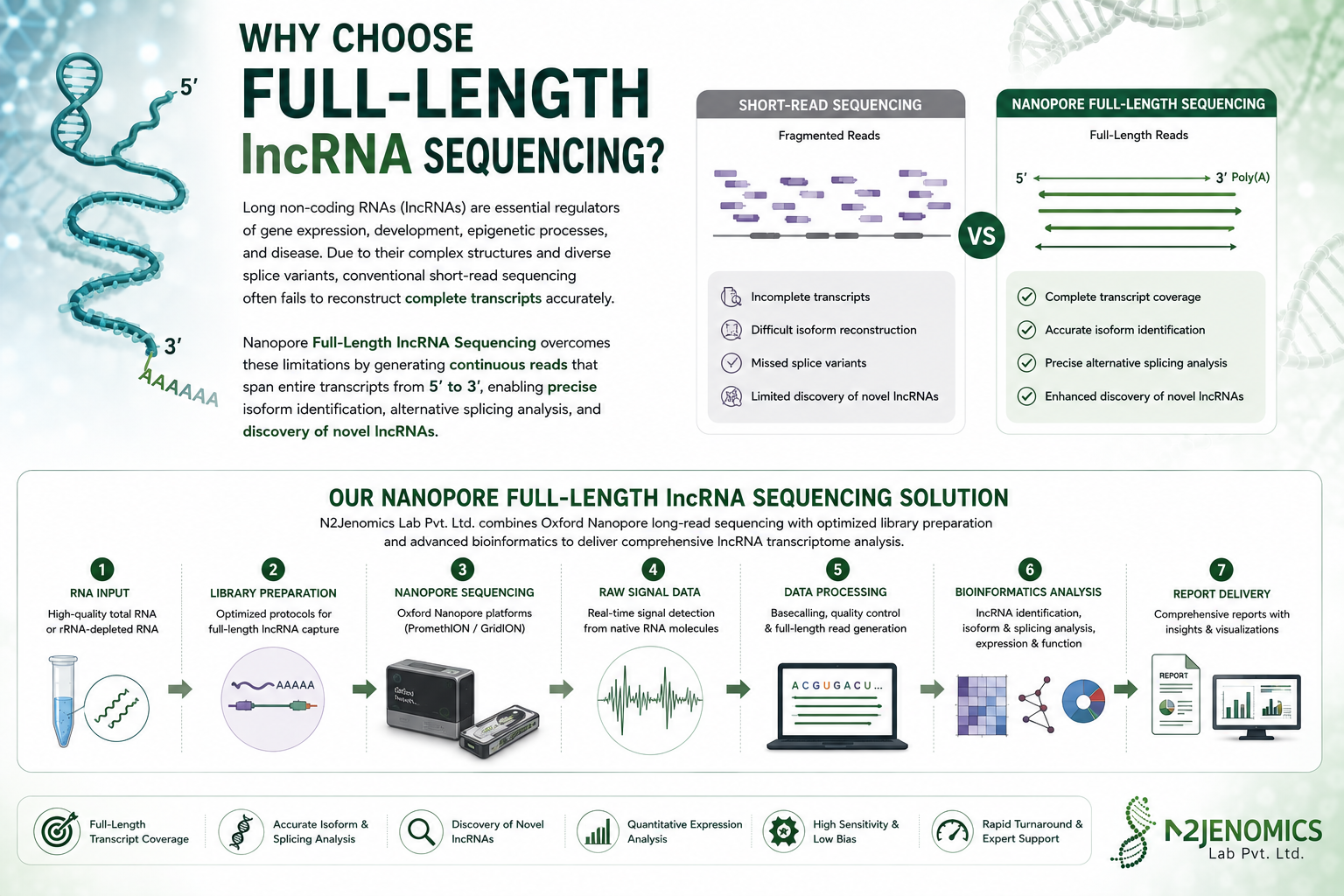
Long non-coding RNAs (lncRNAs) are essential regulators of gene expression, development, epigenetic processes, and disease. Due to their complex structures and diverse splice variants, conventional short-read sequencing often fails to reconstruct complete transcripts accurately.
Nanopore Full-Length lncRNA Sequencing overcomes these limitations by generating continuous reads that span entire transcripts from 5′ to 3′, enabling precise isoform identification, alternative splicing analysis, and discovery of novel lncRNAs.
• Complete transcript coverage for accurate full-length lncRNA sequencing.
• Direct isoform identification without transcript assembly.
• Comprehensive alternative splicing analysis, including exon skipping and intron retention.
• Accurate isoform-level expression quantification.
• Detection of both poly(A)+ and non-polyadenylated lncRNAs.
• Simultaneous profiling of multiple RNA classes, including lncRNA and mRNA.
Benefits for Researchers
• Resolve complex transcript structures with greater confidence.
• Discover novel and low-abundance lncRNAs.
• Improve biomarker discovery through accurate isoform analysis.
• Expand genome and transcriptome annotations.
• Gain deeper insights into RNA regulation and biological mechanisms.
Short-Read vs. Nanopore Full-Length lncRNA Sequencing
Feature
Short-Read RNA-Seq
Nanopore Full-Length Sequencing
Transcript coverage
Fragmented reads
Complete full-length transcripts
Read length
50–300 bp
Up to 20 kb
Isoform detection
Computational reconstruction
Direct identification
Alternative splicing
Limited
Comprehensive
Expression quantification
Gene-level
Isoform-level
Novel lncRNA discovery
Limited
Extensive
Non-poly(A) lncRNA detection
Limited
Supported
Typical applications
Gene expression studies
Isoform discovery, transcript annotation, biomarker research
Why Long-Read Sequencing?
Unlike short-read technologies that rely on transcript assembly, Nanopore sequencing captures intact RNA molecules, providing more accurate transcript structures, improved isoform quantification, and enhanced discovery of previously uncharacterized lncRNAs.
Research Applications
Nanopore Full-Length lncRNA Sequencing is widely used in:
• Developmental biology and tissue-specific transcriptome profiling
• Cancer research and biomarker discovery
• Neuroscience and immunology studies
• Environmental and toxicology research
• Evolutionary and comparative genomics
• Functional characterization of novel lncRNAs
Service Workflow
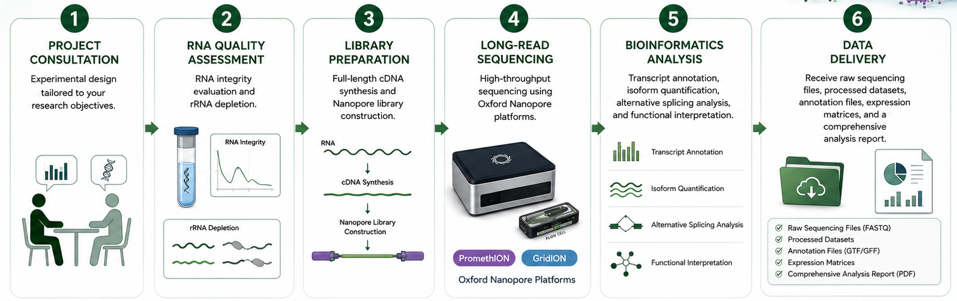
Our streamlined workflow ensures reliable results from sample submission to final analysis.
1. Project Consultation
Experimental design tailored to your research objectives.
2. RNA Quality Assessment
RNA integrity evaluation and rRNA depletion.
3. Library Preparation
Full-length cDNA synthesis and Nanopore library construction.
4. Long-Read Sequencing
High-throughput sequencing using Oxford Nanopore platforms.
5. Bioinformatics Analysis
Transcript annotation, isoform quantification, alternative splicing analysis, and functional interpretation.
6. Data Delivery
Receive raw sequencing files, processed datasets, annotation files, expression matrices, and a comprehensive analysis report.
Bioinformatics Analysis
N2Jenomics Lab Pvt. Ltd. provides a comprehensive bioinformatics pipeline for Nanopore Full-Length lncRNA Sequencing, transforming raw long-read sequencing data into accurate, publication-ready biological insights. Our workflow combines rigorous quality control, transcript annotation, expression analysis, and functional interpretation to enable reliable lncRNA discovery and characterization.
Standard Analysis Workflow
• Quality Control: Evaluate sequencing quality, read length distribution, and overall data performance.
• Read Alignment: Map full-length reads to the reference genome or transcriptome.
• Transcript Assembly & Annotation: Reconstruct full-length transcripts and identify known and novel lncRNAs.
• Filtering & Classification: Remove low-confidence transcripts and classify lncRNAs based on genomic features.
• Expression Quantification: Measure transcript- and isoform-level expression across all samples.
• Differential mRNA Expression: Analyze changes in protein-coding gene expression to complement lncRNA findings.
• lncRNA Target Prediction: Predict potential cis- and trans-regulated target genes to explore regulatory relationships.
• Functional Enrichment Analysis: Perform GO, KEGG, and pathway analyses to reveal the biological functions and pathways associated with differentially expressed genes.
Biological Interpretation
The foundation of our analysis is the identification of statistically significant expression changes between experimental conditions, such as treatment versus control or healthy versus diseased samples. By integrating differential expression, target prediction, and functional enrichment, we help researchers uncover regulatory networks, identify potential biomarkers, and gain deeper insights into the biological roles of lncRNAs in development, disease, and other complex biological processes.
Comprehensive reports include quality metrics, annotated transcript files, expression matrices, differential expression results, functional enrichment analyses, and publication-ready figures to support downstream research and scientific publication.
lncRNA Regulatory Network Analysis
To provide deeper biological insights, N2Jenomics Lab Pvt. Ltd. offers advanced regulatory network analyses that explore interactions among lncRNAs, mRNAs, and miRNAs. These analyses help uncover potential regulatory mechanisms and identify key molecules involved in gene expression and cellular processes.
lncRNA–mRNA Association Analysis
lncRNAs regulate gene expression through cis-acting (co-location) and trans-acting (co-expression) mechanisms. Our analysis integrates differentially expressed lncRNAs with differentially expressed mRNAs to identify potential regulatory relationships.
Key analyses include:
• Identification of lncRNA target genes
• Integration of differential lncRNA and mRNA expression profiles
• Prediction of potential regulatory interactions
• Construction of lncRNA–mRNA interaction networks
lncRNA–miRNA Association Analysis
Many lncRNAs contain miRNA binding sites and interact with miRNAs to influence gene regulation. Using established bioinformatics approaches, we predict interactions between differentially expressed miRNAs and their potential lncRNA targets.
Key Analysis includes:
• miRNA binding site prediction
• Identification of lncRNA–miRNA interactions
• Functional interpretation based on competitive endogenous RNA (ceRNA) mechanisms
lncRNA–miRNA–mRNA Network Analysis
Based on the ceRNA (competitive endogenous RNA) model, lncRNAs can regulate gene expression by competing with mRNAs for shared miRNA binding sites. We construct integrated regulatory networks to identify potential lncRNA-mediated regulatory pathways.
Our workflow provides:
• Identification of shared miRNA binding sites
• Prediction of lncRNA–miRNA–mRNA regulatory interactions
• Construction of ceRNA regulatory networks
• Network visualization and functional interpretation
Why Choose N2Jenomics Lab Pvt. Ltd.?
• Experienced team specializing in long-read transcriptomics and RNA sequencing
• Advanced Oxford Nanopore sequencing platforms and optimized workflows
• Dedicated bioinformatics experts for lncRNA and transcriptome analysis
• Customized research solutions for academic, biotechnology, and pharmaceutical projects
• High-quality data generation, secure delivery, and comprehensive technical support
Deliverables
Each project includes a complete set of sequencing data, analysis results, and publication-ready reports.
• Raw sequencing data (FASTQ)
• Alignment files (BAM)
• Transcript annotation files (GTF/GFF)
• Isoform annotation and expression matrices
• Differential expression analysis results
• lncRNA target prediction and regulatory network analysis
• Publication-ready figures and visualizations
• Comprehensive analysis report (PDF and Excel)
Sample Requirements
Sample Type
Recommended Requirements
Total RNA
≥2 µg
RNA Integrity
RIN ≥7
RNA Purity
OD260/280: 1.8–2.0
Accepted Samples
Fresh/frozen tissues, cultured cells, blood-derived RNA, and FFPE samples (subject to consultation)
Shipping
Transport samples on dry ice to preserve RNA integrity
Our technical team is available to review sample quality, recommend the most suitable library preparation strategy, and provide guidance for specialized or challenging sample types.
1. What is full-length lncRNA sequencing, and how is it different from standard RNA sequencing?
Full-length lncRNA sequencing uses long-read technology to sequence entire lncRNA transcripts from the 5′ end to the 3′ end in a single read. Unlike conventional short-read RNA sequencing, which reconstructs transcripts from fragmented reads, this approach enables direct identification of complete isoforms, alternative splicing events, and novel transcript structures with greater accuracy.
2. What sample quality is required for Nanopore Full-Length lncRNA Sequencing?
High-quality RNA is essential for optimal results. We recommend total RNA with RIN ≥7, high purity (OD260/280 of 1.8–2.0), minimal degradation, and effective rRNA depletion. Intact RNA improves full-length transcript recovery, particularly for long and low-abundance lncRNAs.
3. Can this service identify novel lncRNAs and splice variants?
Yes. One of the major advantages of long-read sequencing is its ability to detect previously unannotated lncRNAs, novel transcript isoforms, and complex alternative splicing events. Because complete transcript structures are sequenced directly, transcript discovery is more accurate than with short-read methods.
4. How accurate is expression quantification?
Nanopore Full-Length lncRNA Sequencing provides reliable isoform-level expression quantification by sequencing complete transcripts rather than fragmented RNA. Advanced bioinformatics and error-correction workflows further improve data accuracy, making this approach well suited for transcriptome profiling and comparative expression studies.
5. Which RNA molecules can be analyzed?
Depending on the library preparation strategy, this service can profile a wide range of RNA species, including poly(A)+ lncRNAs, non-polyadenylated lncRNAs, mRNAs, and other long RNA transcripts. rRNA depletion-based workflows allow broader transcriptome coverage than poly(A)-enrichment methods.
6. What read lengths and deliverables can I expect?
Nanopore sequencing produces long reads that often span entire lncRNA transcripts, enabling comprehensive transcript coverage with minimal assembly bias. Deliverables typically include FASTQ files, alignment files (BAM), transcript annotation files (GTF), isoform expression matrices, quality control reports, and publication-ready analysis reports
7. Is this service suitable for biomarker discovery and disease research?
Yes. Full-length lncRNA sequencing is widely used in biomarker discovery, cancer research, developmental biology, neuroscience, immunology, and translational research. Its ability to identify novel transcripts and resolve complete isoforms makes it a powerful tool for investigating disease mechanisms and discovering candidate biomarkers. This service is intended for Research Use Only (RUO) and is not designed for clinical diagnosis.
8. Do you provide bioinformatics analysis and interpretation?
Yes. Our end-to-end service includes comprehensive bioinformatics analysis, including quality assessment, transcript alignment, isoform identification, differential expression analysis, lncRNA target prediction, functional enrichment, regulatory network analysis, and customized reports with publication-ready figures.
Address:Registered Office: 138, Patparganj Industrial Area, New Delhi – 110092, India
Operational Address: National Institute of Plant Genome Research (BRIC - NGGF)
Lab No. 206 and 207, Aruna Asaf Ali Marg, P.O. Box No. 10531,
New Delhi – 110067, India