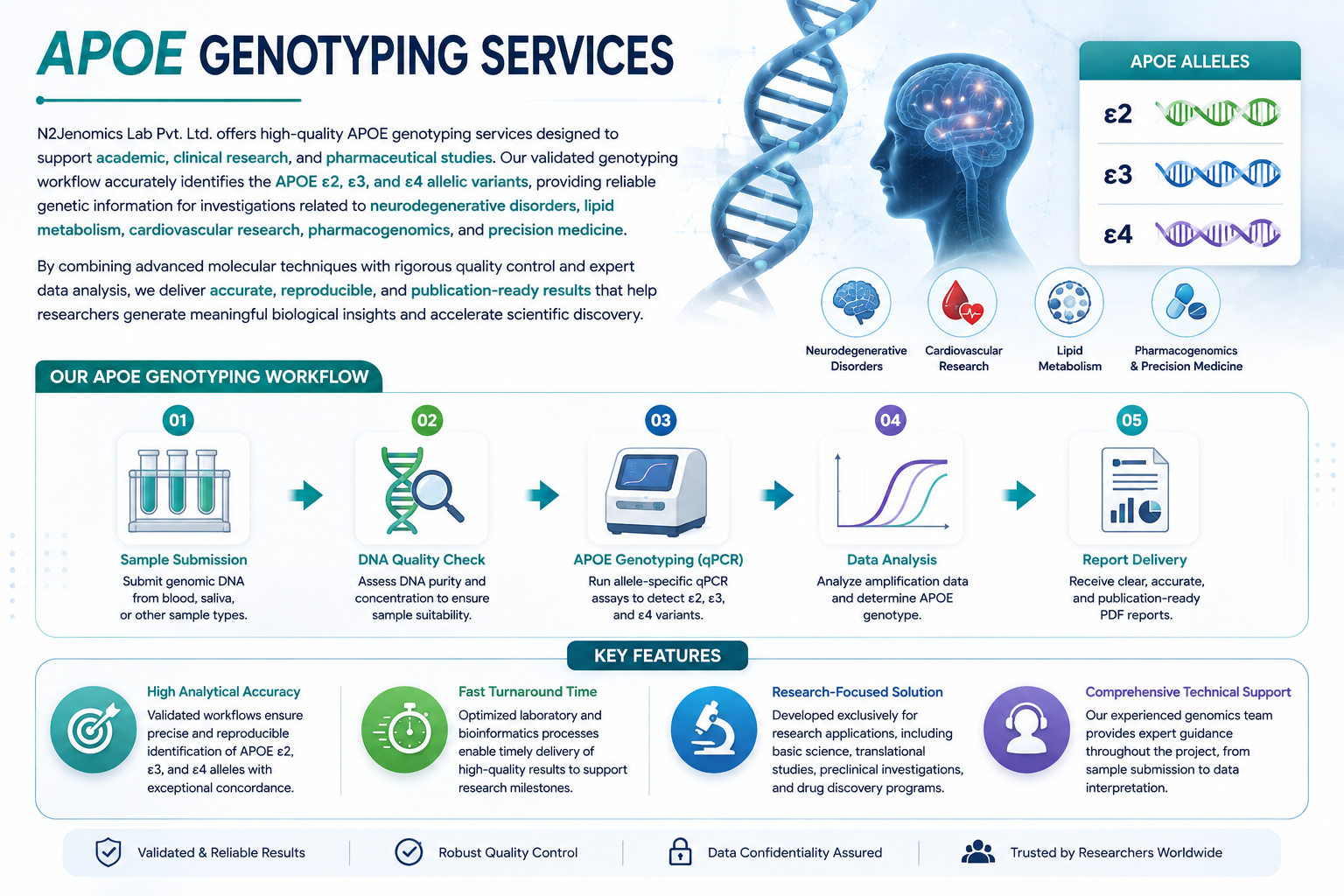
N2Jenomics Lab Pvt. Ltd. offers high-quality APOE genotyping services designed to support academic, clinical research, and pharmaceutical studies. Our validated genotyping workflow accurately identifies the APOE ε2, ε3, and ε4 allelic variants, providing reliable genetic information for investigations related to neurodegenerative disorders, lipid metabolism, cardiovascular research, pharmacogenomics, and precision medicine.
By combining advanced molecular techniques with rigorous quality control and expert data analysis, we deliver accurate, reproducible, and publication-ready results that help researchers generate meaningful biological insights and accelerate scientific discovery.
Key Features
• High Analytical Accuracy – Validated workflows ensure precise and reproducible identification of APOE ε2, ε3, and ε4 alleles with exceptional concordance.
• Fast Turnaround Time – Optimized laboratory and bioinformatics processes enable timely delivery of high-quality results to support research milestones.
• Research-Focused Solution – Developed exclusively for research applications, including basic science, translational studies, preclinical investigations, and drug discovery programs.
• Comprehensive Technical Support – Our experienced genomics team provides expert guidance throughout the project, from sample submission to data interpretation.
APOE genotyping is a molecular genetic analysis used to determine the allelic variants of the Apolipoprotein E (APOE) gene within an individual's genome. The most common alleles—ε2, ε3, and ε4—are identified to support research focused on genetic variation and its biological significance.
The APOE gene encodes apolipoprotein E, a protein that plays a vital role in cholesterol transport, lipid metabolism, and cellular lipid homeostasis. Because of its broad involvement in multiple biological processes, APOE has become an important genetic marker in studies of neurobiology, cardiovascular function, metabolic regulation, aging, and pharmacogenomics.
APOE genotyping enables researchers to accurately characterize genetic variants, facilitating investigations into genotype–phenotype relationships, disease mechanisms, biomarker discovery, and therapeutic development. As a widely adopted tool in genomics research, it provides valuable insights for basic science, translational research, and preclinical studies.
The Biology of APOE Alleles: ε2, ε3, and ε4
The three major APOE alleles (ε2, ε3, and ε4) are defined by amino acid changes at two key positions (112 and 158). These differences are caused by two single nucleotide polymorphisms (SNPs): rs429358 and rs7412. This allelic variation is the primary driver for functional research into the protein's role.
Allele
Key SNP (rs429358)
Key SNP (rs7412)
Amino Acid at 112
Amino Acid at 158
ε2
T
T
Cys
Cys
ε3
T
C
Cys
Arg
ε4
C
C
Arg
Arg
Why is APOE Genotyping Important for Research?
The APOE gene exists in three major allelic forms—ε2, ε3, and ε4—which encode distinct apolipoprotein E isoforms. These naturally occurring genetic variants influence the structure and biological properties of the protein, affecting its interactions with lipids, lipoproteins, and cell surface receptors involved in lipid transport and metabolism.
Characterizing APOE genotype is essential for researchers seeking to understand the molecular mechanisms underlying a wide range of biological processes. Accurate genotyping enables the selection and validation of appropriate experimental models while improving the interpretation and reproducibility of research findings.
Key Research Applications
• Neuronal Lipid Transport – Investigate the role of APOE variants in lipid trafficking, membrane maintenance, and neuronal function.
• Synaptic Function and Plasticity – Examine how different APOE isoforms influence synaptic development, communication, and neural adaptability.
• Amyloid-Beta (Aβ) Biology – Explore the involvement of APOE genotypes in amyloid-beta metabolism, aggregation, and clearance pathways relevant to neuroscience research.
• Cholesterol and Lipid Homeostasis – Study the contribution of APOE genetic variation to cholesterol transport, lipid regulation, and overall metabolic processes.
• Supporting Reliable Research Outcomes - APOE genotyping provides a robust genetic framework for characterizing a wide range of experimental systems, including induced pluripotent stem cells (iPSCs), transgenic animal models, primary cell cultures, and other research specimens. By confirming the APOE genotype before downstream analyses, researchers can strengthen experimental design, improve data reproducibility, and generate more reliable, publication-quality results across basic, translational, and preclinical research.
APOE Genotyping Applications
• For Research Use Only (RUO)
Our high-accuracy APOE Genotyping Service provides reliable genetic characterization to support a broad range of basic, translational, and preclinical research applications. The generated data enables researchers to investigate the biological significance of APOE ε2, ε3, and ε4 alleles across multiple experimental models. This service is intended exclusively for research purposes and is not designed for clinical diagnosis, disease prediction, or patient management.
• Neurodegeneration Research
The APOE gene is one of the most extensively studied genetic factors in neuroscience and neurodegeneration research. Accurate APOE genotyping enables researchers to investigate the molecular and cellular mechanisms associated with neuronal function and neurobiological pathways.
Our service supports studies involving:
- Amyloid-Beta (Aβ) Biology – Examine the influence of APOE isoforms on amyloid-beta production, aggregation, transport, and clearance using in vitro and in vivo experimental models.
- Tau Biology and Neurodegeneration – Investigate the relationship between APOE genetic variants and tau phosphorylation, aggregation, and associated neuronal processes.
- Neuronal and Glial Function – Characterize induced pluripotent stem cell (iPSC)-derived neurons, astrocytes, microglia, and other cellular models to study lipid metabolism, neuronal signaling, synaptic plasticity, and cellular homeostasis.
• Lipid Metabolism and Cardiovascular Research
As a key regulator of lipid transport and cholesterol metabolism, APOE is widely studied in metabolic and cardiovascular research.
Our genotyping service enables researchers to:
- Investigate the functional effects of different APOE alleles on lipid transport and cholesterol homeostasis.
- Study interactions between apolipoprotein E and receptors involved in lipid metabolism, including members of the low-density lipoprotein receptor (LDLR) family.
- Genetically characterize experimental models used in studies of lipid metabolism, atherosclerosis, metabolic regulation, and cardiovascular biology.
• Pharmacogenomics Research
Understanding genetic variation is fundamental to evaluating biological responses during drug discovery and preclinical research.
Our APOE genotyping service supports pharmacogenomics studies by enabling researchers to:
- Explore genotype-dependent differences in molecular pathways and biological responses to investigational compounds.
- Genetically characterize cellular and animal models used in target validation, mechanism-of-action studies, and therapeutic development.
- Support biomarker discovery and precision medicine research by providing reliable genetic information for experimental model selection.
• Cell Line and Animal Model Characterization
Reliable experimental outcomes begin with well-characterized research models. Confirming APOE genotype before initiating downstream experiments helps improve study reproducibility and data interpretation.
Our service is ideal for:
- Cell Line Authentication – Verify the APOE genotype of induced pluripotent stem cells (iPSCs), primary cells, immortalized cell lines, astrocytes, microglia, and other research models.
- Animal Model Validation – Confirm the genetic identity of APOE knock-in, transgenic, or genetically modified animal models to ensure experimental consistency and colony integrity.
- Quality Assurance for Research Models – Establish a validated genetic baseline prior to functional assays, omics studies, drug screening, and long-term research projects.
- Supporting High-Quality Research -
By providing accurate and reproducible APOE genotype information, our service helps researchers strengthen experimental design, improve model validation, and generate robust datasets for neuroscience, cardiovascular biology, pharmacogenomics, and molecular genetics research.
Why Choose N2Jenomics Lab Pvt. Ltd. for APOE Genotyping?
At N2Jenomics Lab Pvt. Ltd., we are committed to delivering accurate, reproducible, and research-grade APOE genotyping solutions that help researchers generate reliable and publication-quality data. Our combination of validated molecular techniques, rigorous quality standards, and dedicated scientific support ensures confidence at every stage of your project.
• High-Quality and Reliable Results
Accurate genotype determination is essential for meaningful scientific research. Our validated genotyping workflow is designed to provide precise identification of APOE ε2, ε3, and ε4 alleles, producing high-confidence data suitable for basic research, translational studies, and preclinical investigations. Every project is performed under stringent quality control measures to ensure consistency and reproducibility.
• Cost-Effective Solution for Large Research Programs
Our optimized workflow enables efficient processing of both small and large sample cohorts while maintaining excellent analytical performance. Whether your study involves a limited number of samples or large-scale population research, our scalable platform provides a practical balance between accuracy, turnaround time, and cost efficiency.
• Personalized Scientific Support
Every research project presents unique challenges. Our experienced genomics scientists and bioinformatics specialists work closely with researchers from project planning through final data delivery, offering guidance on experimental design, sample requirements, result interpretation, and downstream applications to help maximize research outcomes.
• Our APOE Genotyping Platform
Our genotyping platform is designed to deliver reliable, reproducible, and easy-to-interpret results using advanced molecular biology techniques and stringent quality assurance practices.
- Allele-Specific qPCR (AS-qPCR)
Our APOE genotyping service utilizes Allele-Specific Quantitative PCR (AS-qPCR), a highly selective molecular approach for detecting the ε2, ε3, and ε4 allelic variants of the APOE gene. Carefully designed allele-specific primers and fluorescent detection chemistry enable accurate identification of target alleles with excellent analytical specificity and sensitivity.
This targeted approach provides clear genotype determination while minimizing non-specific amplification, making it well suited for research requiring dependable and reproducible genetic data.
Advantages of Our AS-qPCR Workflow
• High analytical specificity for APOE allele discrimination.
• Reliable and reproducible genotype determination across research samples.
• Efficient workflow suitable for both individual studies and high-throughput projects.
• Clear, easy-to-interpret results that support downstream biological analyses.
• Optimized quality control throughout the analytical process.
Robust Performance Compared with Conventional Genotyping Approaches
Several molecular techniques are available for APOE genotyping, each with distinct advantages depending on the research application. Our AS-qPCR workflow is specifically optimized to provide highly specific allele discrimination and consistent analytical performance.
Compared with methods that rely primarily on DNA melting profile analysis, allele-specific amplification directly targets the genetic variants of interest, reducing the likelihood of ambiguous genotype interpretation under appropriately validated assay conditions. This targeted strategy contributes to improved confidence in genotype assignment and supports the generation of high-quality, reproducible research data.
Supporting Reliable Research
By combining validated molecular methods, optimized laboratory workflows, and comprehensive quality assurance, our APOE genotyping platform delivers dependable genetic data for neuroscience, cardiovascular biology, pharmacogenomics, molecular genetics, and other life science research applications. Our goal is to provide researchers with accurate genetic information that supports robust experimental design, reproducible findings, and high-impact scientific discoveries.
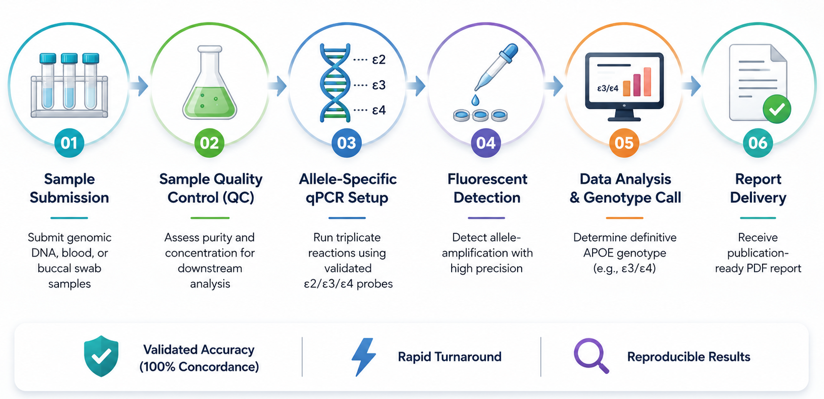
Our APOE Genotyping Workflow
Our APOE genotyping workflow is designed to deliver accurate, reproducible, and timely results through a streamlined process that combines rigorous laboratory practices with comprehensive quality assurance.
Step 1: Project Consultation and Sample Submission
Every project begins with a discussion to understand your research objectives and experimental requirements. Our scientific team provides guidance on sample types, submission procedures, and project planning. We accept a variety of sample materials, including genomic DNA (gDNA), whole blood, and buccal swab samples, following our recommended collection and shipping protocols.
Step 2: Sample Quality Assessment
Upon receipt, all samples undergo a comprehensive quality evaluation to verify their suitability for downstream analysis. Key quality parameters, including DNA concentration, purity, and overall integrity, are assessed to ensure optimal assay performance and reliable genotyping results.
Step 3: APOE Genotyping
Qualified samples are processed using our validated Allele-Specific Quantitative PCR (AS-qPCR) workflow. To ensure high analytical confidence, each assay is performed under stringent quality-controlled conditions with appropriate internal controls and standardized laboratory procedures throughout the testing process.
Step 4: Data Analysis and Reporting
Following laboratory analysis, the generated data are reviewed using validated analytical workflows to accurately determine the APOE genotype. A comprehensive report is then prepared and securely delivered, providing clear genotype results together with relevant technical information to support downstream research and publication.
1. What is APOE genotyping?
APOE genotyping is a molecular genetic test used to identify the allelic variants of the Apolipoprotein E (APOE) gene. The analysis determines the genotype based on two key single nucleotide polymorphisms (SNPs), rs429358 and rs7412, which define the three common APOE alleles: ε2, ε3, and ε4. This information is widely used in basic, translational, and preclinical research.
2. Why is the APOE gene important in biomedical research?
The APOE gene encodes apolipoprotein E, a protein involved in lipid transport and cholesterol metabolism throughout the body, including the central nervous system. Because of its role in numerous biological pathways, APOE is extensively studied in neuroscience, cardiovascular biology, metabolism, pharmacogenomics, and molecular genetics to better understand cellular function and disease mechanisms.
3. What are the APOE ε2, ε3, and ε4 alleles?
The APOE gene exists in three major allelic forms: ε2, ε3, and ε4. These variants arise from differences at two SNP positions, resulting in distinct protein isoforms with unique structural and functional characteristics. The different isoforms influence lipid binding, receptor interactions, and other biological processes, making them valuable genetic markers for research.
4. Which method is recommended for APOE genotyping?
Several molecular techniques can be used to determine APOE genotype, including Allele-Specific Quantitative PCR (AS-qPCR), Sanger sequencing, and next-generation sequencing (NGS). AS-qPCR is widely used for targeted APOE analysis because it offers high analytical specificity, rapid turnaround, scalability, and cost efficiency for research applications. Sequencing methods may be preferred when comprehensive analysis of additional genetic variants is required.
5. How does APOE genotyping differ from DNA sequencing?
APOE genotyping is a targeted assay designed to identify the common ε2, ε3, and ε4 alleles by analyzing the defining genetic variants. In contrast, DNA sequencing examines a larger portion of the gene—or even the entire genome or exome—to identify both common and rare genetic changes. For studies focused specifically on APOE allele determination, targeted genotyping provides a faster and more economical solution.
6. Which sample types can be used for APOE genotyping?
Our APOE genotyping workflow is compatible with a variety of research sample types, including:
• Genomic DNA (gDNA)
• Whole blood collected in EDTA tubes
• Buccal (oral) swab samples
If you are working with other sample types, our scientific team can recommend the most appropriate sample preparation and submission strategy for your project.
7. What is the most accurate approach for APOE genotyping?
The optimal method depends on the objectives of the study. For targeted identification of the APOE ε2, ε3, and ε4 alleles, validated Allele-Specific Quantitative PCR (AS-qPCR) and DNA sequencing are both highly accurate molecular techniques. AS-qPCR provides rapid, reliable, and reproducible genotype determination, while sequencing offers broader genetic analysis when additional variants beyond APOE are of interest.
8. Why is Allele-Specific qPCR commonly used for APOE genotyping?
Allele-Specific Quantitative PCR (AS-qPCR) employs primers specifically designed to recognize individual APOE alleles, allowing highly selective amplification of the target sequence. This targeted approach minimizes non-specific amplification and produces clear genotype results, making it well suited for high-throughput research projects requiring accurate, reproducible, and efficient APOE genotyping.
Address:Registered Office: 138, Patparganj Industrial Area, New Delhi – 110092, India
Operational Address: National Institute of Plant Genome Research (BRIC - NGGF)
Lab No. 206 and 207, Aruna Asaf Ali Marg, P.O. Box No. 10531,
New Delhi – 110067, India