Human Whole Genome PacBio SMRT Sequencing
Home
>
PacBio SMRT Sequencing
> Human Whole Genome PacBio SMRT Sequencing
N2Jenomics Lab Pvt. Ltd. offers Human Whole Genome PacBio SMRT Sequencing to generate highly accurate, long-read genomic data for comprehensive variant discovery. This technology enables the detection of structural variants, haplotype phasing, and DNA methylation, providing valuable insights for precision medicine, disease research, and population genomics.
What Is Human Whole Genome PacBio SMRT Sequencing?
Human Whole Genome PacBio SMRT Sequencing is an advanced long-read sequencing technology that provides a complete view of the human genome. Unlike conventional short-read sequencing, it accurately resolves repetitive regions, structural variants, and complex genomic rearrangements while enabling direct detection of epigenetic modifications.
PacBio HiFi reads typically range from 10–25 kb, delivering exceptional accuracy for comprehensive genome analysis.
Why Choose PacBio SMRT Sequencing?
While short-read sequencing efficiently detects SNPs and small InDels, it has limitations in identifying larger and more complex genomic variants. PacBio long-read sequencing overcomes these challenges by providing:
• Comprehensive structural variant (SV) detection
• Accurate haplotype phasing
• Resolution of repetitive and GC-rich genomic regions
• Direct DNA methylation analysis
• Improved detection of rare and complex genetic variants
These capabilities make it an ideal solution for precision medicine, genetic disease research, and cancer genomics.
Key Advantages
• Long HiFi Reads for accurate detection of structural variants and fusion genes.
• PCR-Free Workflow to minimize amplification bias and improve genome coverage.
• Direct Epigenetic Analysis through native DNA methylation detection.
• High Genome Accuracy for reliable variant discovery across the entire genome.
• Comprehensive Variant Detection, including SNPs, InDels, CNVs, and SVs.
Applications
• Structural Variant (SV) Analysis
Identify insertions, deletions, inversions, duplications, and translocations associated with inherited disorders, cancer, and genomic diversity.
• Haplotype Phasing
Resolve maternal and paternal haplotypes for improved interpretation of inherited variants, HLA typing, and disease-associated alleles.
• DNA Methylation Profiling
Detect native DNA methylation without bisulfite conversion, enabling accurate epigenetic analysis and allele-specific methylation studies.
• Precision Medicine
Support the discovery of disease-causing variants and biomarkers for personalized diagnostics and therapeutic research.
• Population & Clinical Genomics
Characterize genomic diversity across individuals and populations to advance genetic research and disease association studies.
Human Whole Genome PacBio SMRT Sequencing Workflow
Service Specification
Sample Requirements
DNA amount: ≥ 3 μg, Concentration≥80 ng/µL
DNA Purity: OD260/280 =1.8 ~2.0 without degradation or RNA contamination
Sequencing Strategy
20 kb Library
≥ 10X genome coverage depth
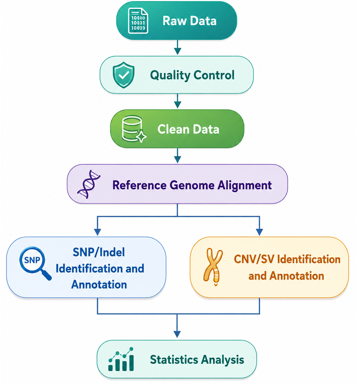
Bioinformatics Analysis N2Jenomics Lab Pvt. Ltd. provides statistical and bioinformatic data analysis services on:
SV detection
Haplotype Genotyping
DNA Methylation
customized bioinformatics services
Analysis Pipeline
Deliverables
• The original sequencing data
• Experimental results
• Data analysis report
• Details in Human Whole Genome PacBio SMRT Sequencing for your writing (customization)
1. What sequencing depth is recommended for human whole genome sequencing?
The optimal sequencing depth depends on your research objective. Generally:
• 30× for standard whole-genome analysis
• 30–50× for germline variant detection and inherited disease studies
• ~10× for large population studies focused on SNP analysis
• >50× for structural variant analysis in cancer and complex genomes
2. How can sequencing results be validated?
Different variant types require different validation methods:
• SNPs: PCR, Sanger sequencing, or SNP genotyping
• InDels: PCR followed by Sanger sequencing
• CNVs: Quantitative PCR (qPCR) or other copy number assays
• Structural Variants (SVs): PCR, long-read sequencing, or cytogenetic methods such as FISH for large rearrangements
3. What are the advantages of PacBio SMRT sequencing over short-read sequencing?
PacBio SMRT sequencing generates long, highly accurate reads that improve the detection of structural variants, repetitive regions, and complex genomic rearrangements. Its PCR-free workflow also enables direct DNA methylation analysis, providing insights beyond conventional short-read sequencing.
4. Why is long-read sequencing preferred for structural variant detection?
Long reads span large genomic regions and repetitive sequences, allowing accurate identification of insertions, deletions, inversions, duplications, and translocations that are often difficult to detect with short-read technologies.
5. How is sequencing data quality assessed?
Quality control includes evaluating:
• Read length distribution
• Sequencing accuracy
• Genome coverage and uniformity
• Overall data completeness and consistency
• These metrics help ensure reliable downstream analysis.
6. How do I choose the appropriate sequencing depth?
The recommended coverage depends on your study goals:
• Genome assembly: High coverage for accurate and complete assemblies
• Variant detection: Moderate to high coverage depending on the variant type
• Structural variant analysis: Higher coverage for improved sensitivity
• DNA methylation studies: Sufficient depth to accurately detect epigenetic modifications
Address:Registered Office: 138, Patparganj Industrial Area, New Delhi – 110092, India
Operational Address: National Institute of Plant Genome Research (BRIC - NGGF)
Lab No. 206 and 207, Aruna Asaf Ali Marg, P.O. Box No. 10531,
New Delhi – 110067, India