Reduced Representation Bisulfite Sequencing (RRBS) is a cost-effective, high-resolution DNA methylation profiling method that enriches CpG-rich regions of the genome. By combining restriction enzyme digestion with bisulfite sequencing, RRBS delivers single-base resolution methylation analysis while significantly reducing sequencing requirements compared to whole-genome approaches.
RRBS is widely used for epigenetic biomarker discovery, differential methylation analysis, and large-scale methylation studies. It provides excellent coverage of CpG islands, gene promoters, and regulatory regions, making it an ideal solution for disease research, developmental biology, and population-scale epigenetic studies.
How RRBS Works
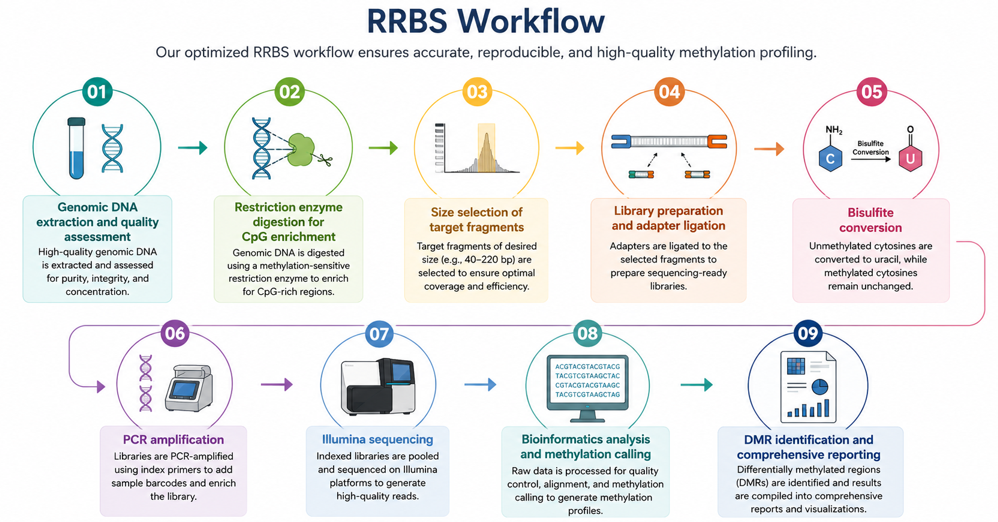
RRBS selectively enriches CpG-rich genomic regions through restriction enzyme digestion, followed by bisulfite conversion and next-generation sequencing.
The standard workflow includes:
• Restriction enzyme digestion to enrich CpG-rich fragments
• Size selection of target DNA fragments
• Library preparation with adapter ligation
• Bisulfite conversion
• PCR amplification
• High-throughput sequencing
• Bioinformatics analysis and methylation profiling
For mammalian samples, MspI is commonly used, while alternative enzymes such as SacI/MseI are often employed for plant genomes due to their distinct methylation landscapes.
Advantages of RRBS
• Single-base resolution DNA methylation analysis
• Cost-effective alternative to whole-genome bisulfite sequencing
• Enrichment of CpG islands, promoters, and regulatory regions
• Low DNA input requirements
• Simultaneous detection of DNA methylation and sequence variants
• Suitable for biomarker discovery and large cohort studies
• High reproducibility and sequencing efficiency
Applications
• Cancer Research
Identify differentially methylated regions (DMRs), discover epigenetic biomarkers, and investigate cancer-associated methylation changes.
• Developmental Biology
Study DNA methylation dynamics during embryonic development, cell differentiation, and stem cell biology.
• Neuroscience
Explore epigenetic alterations associated with neurological disorders, cognitive function, learning, and memory.
• Evolutionary and Ecological Research
Compare methylation patterns across species or populations to investigate evolution, adaptation, and environmental responses.
• Agricultural Science
Analyze methylation profiles associated with crop improvement, stress tolerance, disease resistance, livestock breeding, and other agriculturally important traits.
All DNA should be RNase-treated and should show no degradation or contamination.
Note: Sample amounts are listed for reference only. For detailed information, please contact us with your customized requests.
Sequencing Strategies
RRBS library preparation
Illumina HiSeq X Ten, paired-end 150 bp
Sequencing depth > 50M clean reads
More than 80% of bases with a ≥Q30 quality score
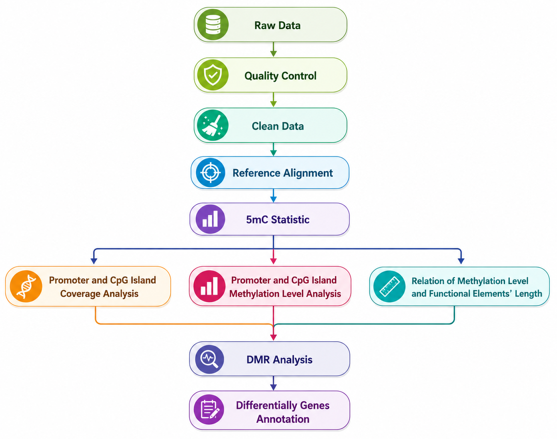
Data Analysis We provide multiple customized bioinformatics analyses:
Alignment against reference genome
Promoter and CpG islands coverage analysis
Promoter and CpG island methylation level analysis
DMR (differentially methylated region) analysis
Functional annotation of differentially expressed genes
Relation of methylation level and functional elements' length
CpG region distribution
Regional distribution of genes
Note: Recommended data outputs and analysis contents displayed are for reference only. For detailed information, please contact us with your customized requests.
Analysis Pipeline
Deliverables
• The original sequencing data
• Experimental results
• Data analysis report
• Details in reduced representation bisulfite sequencing for your writing (customization)
1. What is the workflow of RRBS?
The standard RRBS workflow enriches CpG-rich genomic regions for high-resolution methylation analysis while minimizing sequencing costs.
Typical workflow:
• Genomic DNA extraction and quality assessment
• Restriction enzyme digestion (commonly MspI for mammalian genomes)
• Size selection of CpG-enriched DNA fragments
• End repair, adapter ligation, and library preparation
• Bisulfite conversion
• PCR amplification
• High-throughput sequencing
• Bioinformatics analysis, methylation calling, DMR identification, and comprehensive reporting
2. What sample types are suitable for RRBS?
RRBS is compatible with a variety of sample types, including:
• High-quality genomic DNA
• Fresh or frozen tissues
• Cultured cells
• Blood and other biological samples
• For optimal results, samples should have high DNA integrity, minimal contamination, and sufficient concentration. Proper storage and cold-chain transportation are recommended to preserve DNA quality before sequencing.
3. Which species are suitable for RRBS?
RRBS is suitable for a wide range of eukaryotic organisms, including humans, animals, and plants. The best results are achieved when a high-quality reference genome and comprehensive genome annotation are available, enabling accurate alignment, methylation calling, and downstream epigenetic analysis.
Address:Registered Office: 138, Patparganj Industrial Area, New Delhi – 110092, India
Operational Address: National Institute of Plant Genome Research (BRIC - NGGF)
Lab No. 206 and 207, Aruna Asaf Ali Marg, P.O. Box No. 10531,
New Delhi – 110067, India